|
HCM City
enhances use of IT disease surveillance
HCM City will expand the use of geographic information system (GIS)
technology this year for surveillance of infectious diseases, such as
hand-foot-mouth, throughout the city after successfully piloting it for
dengue fever, the city’s Preventive Medicine Centre department’s deputy
director Nguyen Huu Hung told Viet Nam News.
Last
year, the city recorded nearly 5,000 patients with hand-foot-mouth disease,
according to the preventive medicine centre.
“This
IT application, especially the GIS technology, was one of the methods which
the city applied last year to help reduce new dengue fever incidences,” Hung
added.
According
to the city’s Preventive Medicine Centre, the city last year reported more
than 19,500 cases of dengue fever, dropping from 22,099 in 2016. Last year,
six people died due to the disease while five died in 2016.
The
city saw a decrease in new incidents of the Zika virus infection, which is
transmitted by Aedes mosquitoes, with only 21 cases last year while it
reported 190 in 2016.
Of
the 21 Zika patients, 13 were pregnant women.
Dr
Nguyen Tri Dung, the centre’s head, said that the centre last year used GIS
technology to collect information on dengue fever patients, to monitor
outbreaks and track the spread of diseases on a digital map of the city’s
wards and communes, and to respond effectively to disease outbreaks.
The
city had 20,844 dengue-fever high risk areas listed and monitored, Dung said,
adding that 80 per cent of them were under periodic surveillance.
Hung
said that 16 districts have imposed strict fines for individuals, households
and organisations which failed to obey regulations on preventive methods
against dengue fever, including allowing water containers with mosquito larvae.
“Last
year, the city issued the highest number of fines, with 400, an increase of
257 fines in 2016,” Hung added.
He
said that the Department of Health will continue to sign join agreements with
other departments in the city to co-operate for the regular prevention and
surveillance of diseases.
“Moreover,
it will equip districts with more spraying machines and other equipment. More
training courses for health officials will be opened. Because it is difficult
to forecast disease development, we should take the initiative in
prevention,” Hung said.
VNS
|
Thứ Ba, 2 tháng 1, 2018


|
HCM City
builds on 2017’s remarkable achievements
The
significant socio-economic-cultural accomplishments that the southern
economic hub of Ho Chi Minh City gained in 2017 will create a firm foundation
for its stronger development in 2018 and the following years.
 Important milestones In 2017, the city recorded an 8.25% increase in gross regional domestic product (GRDP), higher than the 8.05% growth in the previous year. The economic structure shifted towards higher proportion of high-quality, high added value and highly competitive services. The export turnover was valued at US$35.2 billion, up 15.1%.
Domestic
investment, including registered and supplemented capital, reached over
VND899 trillion (US$39.5 billion), three fold against 2017, while foreign
investment hit US$6.38 billion, doubling the figure of the previous year.
HCM City received US$5.2 billion in foreign remittances, 70% of which were poured into investment, being an important financial resource to boost business production. The index of industrial production (IIP) increased by 7.9% with four main industries of mechanics-manufacturing, electronics-information technology, chemical industry-plastic-rubber, and food processing recording annual average growth of 15.5%. Production value at hi-tech parks was valued at US$12 billion. The city channelled over VND347.9 trillion (US$15.3 billion) for the State budget, representing a year-on-year rise of 12.94%. The good growth rate in 2017 creates an impetus for the city to strive for stronger development in 2018 and fulfill the target of an economic growth of 8.5% in 2015-2020. More rapid and sustainable development 2018 is the first year HCM City will implement Conclusion 21 of the Politburo and Resolution 54 of the National Assembly, which allow the city to pilot specialised policies and mechanisms for more rapid and sustainable development. According to Chairman of the municipal People’s Committee Nguyen Thanh Phong, HCM City will focus on supplementing and promulgating legal documents and consulting related ministries and sectors on revising laws, decrees and circulars related to the specialised policies and mechanisms this year. The municipal authorities have outlined 8 groups of tasks and key measures to increase growth quality and economic competitiveness as well as ensure healthy investment environment and encourage innovation, start-up movements and business development. The city will focus investment on major infrastructure projects to ease traffic congestion and accidents, reduce inundation and environmental pollution, and cope with climate change. At the same time, attention will be paid to ensuring social welfare, reforming administrative procedures, accelerating the building of smart city and e-governance, maintaining social-political order and stability, and expanding external relations and international integration. It will continue supporting small-and medium-sized enterprises (SMEs) to increase their competitive edge to engage in global value chains, especially in the fields of processing, manufacturing, electronics, and information technology. VOV |
|
Pedestrians unaware of new traffic violation penalties
Many
pedestrians in

Crossing the street in HCM City
All traffic participants,
including pedestrians, will face up to 15 years of imprisonment if the
violations cause deaths, serious injuries or damages.
Many people continue to ignore the pedestrian walkway near The traffic on 
Pedestrian ignores elevated walkway near
Around
Only five out of 15 asked people said they knew about the new penalties for pedestrians. "The street is not crowded at noon so we just saved some time," one of them said. Lawyer Nguyen Anh Minh from HCM City Bar Association supported the penalties. Anh said if the pedestrians climbed the divider to cross the street, they might surprise a motorist and could cause an accident. Pedestrians could be jailed for 10 to 15 years for bad or fatal traffic accidents. According to HCM City Police, they had issued warnings to 495 pedestrians in 2017. In the coming time, they will raise public awareness about traffic rules and implement stricter penalties.
nguoilaodong
|
Lack of English-language signage, announcement may drive
tourists away from
International tourists are confused
when an announcement in Vietnamese is made via loudspeakers.
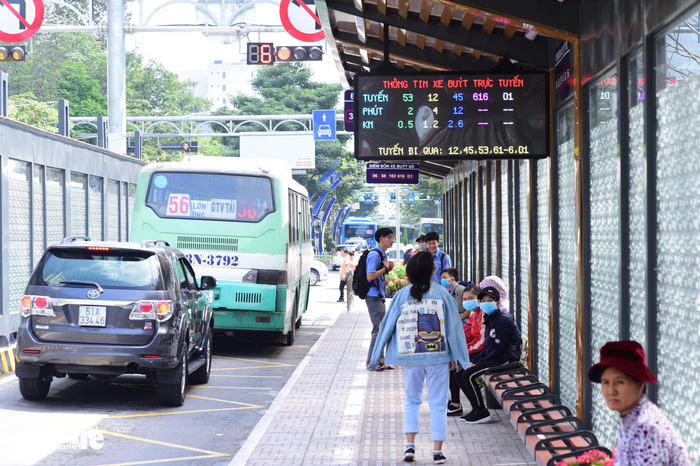
An electric board displaying
information only in Vietnamese is seen at a newly opened bus station in
It is not uncommon for foreign
tourists to feel uncomfortable when they travel by public transportation in
Except for airports, few venues in
This is a reality in
Confusion for English-speaking
tourists
It is a real challenge for foreign visitors to follow
instructions or announcements made via the loudspeaker systems at bus
stations, as the information is only available in Vietnamese.
In a piece sent to Tuoi Tre (Youth) newspaper
last week, a reader named Xuan Dao recounted a situation she witnessed at the
newly-opened river bus station in Ho Chi Minh City to illustrate how this
lack of English-language information may affect international holidaymakers.
“So a station attendant was announcing via the
loudspeakers that passengers departing at 11:30 am should start boarding when
I noticed that a foreigner who bought that ticket stood still, unaware that
the announcement was meant for him,” Dao wrote.
The reader said this is obviously not an exceptional
case, as the river bus, the first of its kind in
“Many foreigners have come to the station and were all
confused and even missed the boarding announcement because the information
was not delivered in English,” Dao said.
The reader went on to say that bus stops across the
city also lack the English version for the route itinerary and timetable,
keeping many international visitors from using the public transportation.
“An American tourist told me that he would never travel
by bus in
At the Saigon Rail Station, the guidelines for buying
and returning train tickets at the box office are also lacking in an English
version, Dao added.
Non-English signage, announcement everywhere
Similarly, when a new bus station
was inaugurated in downtown
“[This is] typical and then they wonder why tourists
never return,” Quinn wrote.
Such a complaint is not something new from the expat
community or foreign tourists in
In 2015, Tuoi Tre opened an online discussion
on how to improve the service quality of the Vietnam Railways, and received a
number of complaints about the dearth of trash cans, unhygienic restrooms and
the lack of announcements
in English on trains operated by the state-run company.
“With all information announced in Vietnamese, how
could foreign tourists who travel on their own know what to do when there are
changes to schedules or other things?” one reader said.
“If possible, the announcements should also be
available in English.”
At that time, Dinh Van Sang, deputy general director of
the Saigon Railways, even admitted that while announcements on trains were
made in Vietnamese and English, “unexpected notices are not available in
English.”
Tuoi
Tre News
|


Thứ Hai, 1 tháng 1, 2018
|
Ranked ninth
among foreign investors in VN, the US seeks better policies
US
investors poured $10 billion worth of FDI (foreign direct investment)
into Vietnam by October 2017, becoming the ninth largest foreign investor in
Vietnam among 128 countries and territories, according to FIA (Foreign
Investment Agency).

Foreign investors
registered $33 billion worth of investment capital in the first 11 months
In 2017, South Korea invested $57
billion, Japan $46.3 billion, Singapore $41.7 billion and Taiwan $30.8
billion.
Amcham’s Managing Director Adam Sitkoff said to attract investors, it is necessary to create a good business environment, which improves productivity and reduces costs. Amcham’s members often meet problems in Vietnam – inconsistent policies and unfair treatment. Citing the draft Cyber Security Law, Sitkoff said it is ‘special’ because, besides the measures to protect cyber security, it includes provisions to control information on the internet, though the issue is covered by other laws.
He
also pointed out that tentative regulations that require foreign service
providers to have hosts in Vietnam is unreasonable, which won’t help improve
cyber security and will create unnecessary burdens for foreign companies.
Sitkoff also pointed out the inconsistency between the Pharmacy Law and Decree 54 that guides the implementation of the law. The enforcement of the decree will force some foreign investors to stop providing storage and transportation services though they were licensed, he said. This would cause losses of hundreds of millions of dollars and interruption of essential drugs. He went on to say that imposing a luxury tax on soft drinks is uncommon and not encouraging. Meanwhile, the requirements in Decree 38 that guides the implementation of the Food Safety Law have had a big impact on the food & beverage industry, but no change in state management. Economists commented that Vietnam needs foreign capital, but foreign technology even more. And investments from the US, Europe and Japan can bring high technologies. FIA’s deputy director Nguyen Noi admitted that there are still problems in attracting FDI that need to be fixed in the context of the 4.0 revolution, which will lead to changes in FDI structure and trend. Nguyen Van Toan, deputy chair of VAFIE (Vietnam Association of Foreign invested Enterprises), believes that the problems lie in transparency in investment and economic relations and administrative procedures. Moreover, Vietnam’s limited capability of absorbing capital has caused US investors to be cautious. According to Noi, the foreign invested sector makes up 20 percent of GDP and 70 percent of export turnover. In the first 11 months, foreign investors registered $33.09 billion worth of investment capital.
Chi Mai, VNN
|
|
|
|
|
Foreign investors flock to
limited-availability bank stocks
In 2017,
Vietnamese banks have regained their appeal to foreign investors, after a
long period of restructuring. Major share sales such as HDBank and VPBank in
the last months of 2017 have raised millions of USD for the banks and
attracted a great number of buyers from overseas.
 In its latest report in 2016, Fitch ratings agency noted that the creditworthiness of Vietnamese banks is still the lowest in Asia. This remark shows that the banking system still has a lot of problems to be solved, ranging from restructuring to bad debts and lack of capital. This is especially important when Vietnam’s banks are about to adopt the Basel II standards. This viewpoint was reflected in an article on Bloomberg View last September. “Vietnamese banks lack capital,” the article says. As the amount of bad debt had yet to be fully reflected, the situation may be even more serious than what the official statistics show. However, this challenge also creates opportunities for the banks to raise new capital and push the return of foreign capital to Vietnamese lenders. “In investors’ eyes, Vietnamese banks are one of the most feasible targets in Asia,” said Bloomberg. This comment was backed by the strong economic rebound of Vietnam in recent years and the steady recovery of the Vietnamese real estate industry. The banking sector, although still struggling with the high amount of bad debts, has recovered in many other aspects. Credit growth—one of the most important signs of recovery—is experiencing a boost as well. The return of million-dollar deals Vietnams’ banks started their comprehensive overhaul in 2008—and it is only in 2017 that they began to attract foreigners’ attention again, in deals worth of millions of USD. Most recently, HDBank has raised $300 million from international investors after selling shares to existing investors in the book-building method. The $300-million deal was the second largest ever in the Vietnamese banking sector, just below Vietcombank’s $460-million deal in 2007. The number of registered purchases tripled the amount of shares on offer. Participants in this share sale were major financial institutions from around the world, such as Credit Saison (Japan), Deutsche Bank AG (Germany), JPMorgan Vietnam Opportunities Fund, CAM Bank (Japan), Charlemagne (UK); Dragon Capital, VinaCapital, and Macquarie Bank (Australia) or PYN Elite. Prior to HDBank, VPBank also completed raising $250 million from its share deal in May. The number of registered purchases, as revealed by the advisors, was $1.2 billion. The success of these two auctions has showcased the increasing size of transactions in the Vietnamese banking system, as well as the size of the selling price. A year ago, except for Vietcombank, bank stocks traded at only 1x, and some banks on the over-the-counter market even traded below their share value. However, nowadays, the value of some promising lenders has tripled to 3x or 4x. In the HDBank auction, investors were willing to pay VND32,000 ($1.4) and expected this figure to rise even higher when the lender makes its debut on the stock exchange in early 2018. These transactions also created a buzz in the stock market, signalling the return of Vietnam’s “king stocks.” This is especially true as investors often use the selling price in the pre-IPO share sale as the benchmark for their investments. Opportunities are not for everyone Promising stories about banks’ raising capital can make it seem like every lender is now taking in money left and right. However, the perception is not always true. Even the four major banks on the market are running into problems when raising first-tier capital. In the past year, Vietcombank did not manage to solve the delay in selling its stakes to Singapore’s sovereign fund GIC. Previously in August 2016, GIC has agreed to buy 306 million Vietcombank shares, or 7.7 per cent of the stakes. The reason for the delay is disagreements in pricing, as GIC offers to pay only $400 million, much lower than the $640 million market price of this share batch. BIDV, the largest bank by assets, is also facing difficulties in raising capital. The bank’s capital adequacy ratio is already reaching dangerous levels. A Korean partner is rumoured to have expressed interest in BIDV, but there is no concrete information on the sale yet. Apart from finding the right partner, the foreign ownership limit (FOL) is another major hindrance for banks. Both VPBank and HDBank still have 10 per cent of their shares available for foreign investors, which is partly why the share sales were a success. VPBank’s FOL was reached immediately upon listing, while HDBank still has 8.5 per cent left. Meanwhile, at Vietinbank, the FOL is now encroaching the 30-per-cent limit. The tiny remaining stake is only enough for small-scale daily trading and is certainly not sufficient for a strategic investor. The bank’s financial health is another major factor. As of December 30, HDBank had VND180.8 trillion ($3.56 billion) of assets and VND14 trillion ($617.4 million) of owners’ equity. HDBank expects to earn VND2.4 trillion ($105 million) in pre-tax profit this year, up 130 per cent from the same time last year. HDBank has shown great progress in recent years. Compared to 2011, the total amount of assets as well as owners’ equity tripled and deposits grew fourfold. Credit increased fivefold, while pre-tax profit doubled. With close relationships with major partners like Vietjet Air, Vinamilk, and consumer finance firm HDSaison, HDBank is attracting significant attention from international investors. The bank is expected to grow faster than the industry average in the next five years.
VIR
|
|
|
|
|
|
2017 – one of most successful years
of diplomatic sector, official says
2017
is regarded as one of the most successful years of diplomatic sector,
according to Deputy PM, FM Pham Binh Minh.

Deputy PM, FM Pham Binh Minh
In his recent article,
Deputy PM, FM Minh wrote diplomatic work was deployed in an active, proactive
and drastic manner in both bilateral and multilateral aspects, contributing
to the country’s overall socioeconomic achievements.
Most prominently, Vietnam excellently hosted the APEC Year, especially the APEC Economic Leaders’ Week in the central city of Da Nang, creating positive and multidimensional effects and giving prominence to Vietnam as the host of the such global-level event. For the first time in decade, all APEC economic leaders attended the Leaders’ Meeting while a record number of delegates and reporters flew to Vietnam for various meetings during the APEC Year. Vietnam created good impressions on international friends from organization work to security guaranteeing. The APEC Year was a vivid example of that fact that multilateral diplomacy has been heightened and shifted to proactively contribute to building and shaping common rules of the game, thereby helping to protect and accelerate the country’s strategic interests in terms of security and development while demonstrating the responsibility spirit of Vietnam in the international community. The success of the APEC year has generated new confidence, new power, and new momentum for the country’s international integration process and promoted the national pride, self-reliant spirit and desire of Vietnamese people and business community to better themselves. Vietnam made great efforts in fostering and deepening cooperation with neighboring countries, major partners and traditional friends. The Vietnamese leaders conducted 18 foreign visits, attended eight multilateral conferences, and welcomed 36 turns of foreign leaders to Vietnam. Especially, during the APEC Economic Leaders’ Week, Vietnam welcomed State visits by Chinese Party General Secretary and President Xi Jinping, US President Donald Trump; official visits by Chilean President Michelle Bachelet and Canadian PM Justin Trudeau while conducted over 50 bilateral contacts and meetings with leaders of APEC economies. In economic front, Vietnam also continued focusing on carrying out the Resolution No. 06 of the 12th Party Central Committee on effective implementation of the international economic integration in the context of joining new-generation free trade agreements. Vietnam worked with the relevant countries to forge the Trans-Pacific Partnership (TPP) ahead. The trade deal is now renamed as the Comprehensive and Progressive Agreement for Trans-Pacific Partnership. Vietnam is also an active member in the talks on the Regional Comprehensive Economic Partnership (RCEP) and accelerating official signing of a free trade agreement with the European Union (EVFTA). Efforts in international economic integration have brought about encouraging outcomes. Export values reached all time high of US$425 billion. The number of foreign foreign arrivals increased by 30% to 13 million. During the APEC Economic Leaders’ Week, Vietnam signed agreements worth up to US$20 billion. At present, as many as 69 countries have recognized Vietnam’s market economy status. Regarding major orientations for 2018, Vietnam will continue promoting the success of the APEC Year 2017 and further deepening external relations in a more effective and sustainable manner. Vietnam will actively prepare for assuming the ASEAN Chair in 2020, continue its bid to win a non-permanent seat on the United Nations Security Council for the tenure 2020 – 2021, and resolutely and consistently protect its sovereignty, territorial integrity, and national security.
VGP
|
Đăng ký:
Bài đăng (Atom)