|
18 noteworthy skywatching events in 2014
The people in
Quadrantids meteor shower
Quadrantids - one of the largest
meteor showers in 2014 reached its maximum at dawn on January 4.
The Quadrantids is the first major
meteor shower of the year. It is usually active between the end of December
and the second week of January, and peaks around January 2 or January 3.
However, unlike other meteor showers that tend to stay at their peak for
about two days, the peak period of the Quadrantis is only for a few hours.
In 2014, the Quadrantids peaked on
January 3. A new Moon on January 1, 2014 created ideal viewing conditions for
those in the Northern Hemisphere. According to astronomers, those in the
eastern part of
The shower owes its name to the now
defunct constellation Quadrans Muralis. The constellation was left off a list
of constellations drawn out by the International Astronomical Union (IAU) in
1922, but because the shower had already been named after Quadrans Muralis,
its name was not changed. The Quadrantids is also sometimes called Bootids after
the modern constellation, Boötes.
The Quadrantids are associated with
an asteroid - the 2003 EH1. The asteroid takes about 5.5 years to orbit
around the Sun.
Earth passes between Jupiter
Earth passes more or less between the
sun and Jupiter, placing Jupiter opposite the sun in our sky. Astronomers
call this event an opposition of Jupiter. This phenomenon occurred on January
5. The 2014 opposition is Jupiter’s closest point until 2020. Jupiter rises
at sunset, is highest in the sky at midnight and sets at dawn. It shines more
brightly than any star in the evening sky. It blazes away in front of the
constellation Gemini, near the bright Gemini stars, Castor and Pollux.
Jupiter comes to opposition about
every 13 months. In other words, that’s how long Earth takes to travel once
around the sun relative to Jupiter. Jupiter’s closest approach to Earth for
the year always falls on or near this planet’s opposition date. In 2014,
Jupiter came nearest to Earth on January 5. Then Jupiter was only 391 million
miles (630 million kilometers) away.
Jupiter is sometimes called a failed
star. You would need at least 80 Jupiters – rolled into a ball – to be hot
enough inside for thermonuclear reactions to ignite. In other words, Jupiter
is not massive enough to shine as stars do.
But Jupiter is the largest planet in
our solar system. So when the sun goes down on this early January night, you
might — if you’re fanciful enough — imagine bright Jupiter as a tiny sun all
night long.
Lyrids meteor shower
Every year in late April Earth passes
through the dusty tail of Comet Thatcher, and the encounter causes a meteor
shower--the Lyrids. This year the shower peaks on April 22nd-23rd.
Forecasters expect 10 to 20 meteors per hour, although outbursts as high as
100 meteors per hour are possible.
Lyrid meteors appear to stream from
the bright star Vega in the constellation Lyra. In fact, Lyrids have nothing
to do with Vega. The true source of the shower is Comet Thatcher. Every year
in April, Earth plows through Thatcher's dusty tail. Flakes of comet dust,
most no bigger than grains of sand, strike Earth's atmosphere traveling 49
km/s (110,000 mph) and disintegrate as streaks of light.
Lyrid meteors are typically as bright
as the stars in the Big Dipper, which is to say of middling brightness. But
some are more intense, even brighter than Venus. These "Lyrid
fireballs" cast shadows for a split second and leave behind smoky debris
trails that linger for minutes.
Occasionally, the shower intensifies.
Most years in April there are no more than 5 to 20 meteors per hour during
the shower's peak. But sometimes, when Earth glides through an unusually
dense clump of comet debris, the rate increases. Sky watchers in 1982, for
instance, counted 90 Lyrids per hour.
Eta Aquarids meteor shower
The Eta Aquariids are a meteor shower
associated with Halley's Comet.
The shower is visible from about May
5-6 this year in
Although this shower is not as
spectacular as the Leonids, it is not an ordinary event. The Eta Aquariids
get their name because their radiant appears to lie in the constellation
Aquarius, near one of the constellation's brightest stars, Eta Aquarii. The
shower peaks at about a rate of around a meteor per minute, although such
rates are rarely seen from northern latitudes due to the low altitude of the
radiant.
The Eta Aquariids are best viewed in
the pre-dawn hours away from the glow of city lights. For northern observers,
the radiant of the shower is only above the horizon for the few hours before
dawn, and early-rising observers are often rewarded with rates that climb as
the radiant rises before sunrise. The shower is best viewed from the equator
to 30 degrees south latitude.
Mars at opposition
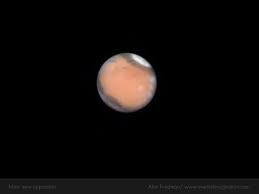
Mars will be well placed for
observation, lying in the constellation Virgo, far above the horizon for much
of the night. Regardless of your location on the Earth, Mars will reach its
highest point in the sky at around midnight local time.
This optimal positioning occurs when
Mars makes its closest approach to the point directly opposite to the Sun in
the sky – an event termed opposition, the exact moment of which will be 03:57
ICT. Since the Sun reaches its greatest distance below the horizon at
midnight, the point opposite to it is highest in the sky at the same time.
At around the same time that Mars
passes opposition, it also makes its closest approach to the Earth – termed
its perigee – making it appear at its brightest and largest in the night sky.
This happens because when Mars lies opposite to the Sun in the night sky, the
Solar System is lined up so that Mars, the Earth and the Sun lie in a
straight line with the Earth in the middle, on the same side of the Sun as
Mars.
The time of Mars's perigee is an
especially good time to observe it, since it neighbors the Earth in the Solar
System and has the greatest variation of all of the planets in its distance
from the Earth. This correspondingly means that it also has the greatest
variation in its apparent size and brightness in the night sky.
When it passes opposition, Mars's
sweeps past the Earth rather quickly, and so only appears large and bright in
the sky for a few weeks. Whereas the Solar System's outer gas giants are so
far from the Sun that their distance do not change very much depending upon
the Earth's relative position in its orbit, Mars's distance from the Earth
can vary between 0.36 AU and 2.68 AU, meaning that its disk varies in
diameter between 25.68" and 3.49".
On this occasion, Mars will lie at a
distance of 0.62 AU, and its disk will measure 15.1 arcsec in diameter,
shining at magnitude -1.4. Even at its closest approach to the Earth,
however, it is not possible to distinguish it as more than a star-like point
of light with the naked eye, though a simple pair of binoculars are
sufficient to reveal it as a disk of light.
Over the weeks following its
opposition, Mars will reach its highest point in the sky four minutes earlier
each night, gradually receding from the pre-dawn morning sky whilst remaining
visible in the evening sky for a few months.
The best time to observe this
phenomenon is May 10.
Moon, Mars out from nightfall till
after midnight June 7
As darkness falls on June 7, look for
the waxing gibbous moon to huddle up with the red planet Mars. The moon and
Mars both reside in front of the constellation Virgo, not real far from
Spica, Virgo’s brightest star. You’ll have plenty of time to catch the
evening couple – the moon and Mars – as twosome will be out until the wee
hours after midnight.
Ancient astronomers were greatly
confounded at Mars’ extreme variation in brightness. At its brightest, Mars
is about 75 times brighter than at its faintest. It was hard for the ancients
to understand why the red planet brightened, dimed and then brightened again
over a cycle of about two years.
Copernicus explained that it’s
because Mars and Earth both orbit the sun. When Earth and Mars are on the
same side of the sun, the distance between Earth and Mars is less, so Mars
shines more brightly in Earth’s sky. In the following year, when Mars and
Earth are on opposite sides of the sun, Mars appears less bright because it’s
farther away from Earth.
Mars is lodged about 7 times farther
away at its farthest than at its closest to Earth. Therefore, Mars’ apparent
diameter shrinks to 1/7th of its size of when Mars was at its closest. Yet,
that 1/7th-figure doesn’t tell the whole story. At its farthest, Mars’ disk
size is actually 1/49th as great because you have to square the change in
apparent diameter to find out how much its disk has shrunk (1/7 x 1/7 =
1/49).
Next year, in June 2015, Mars will
pass behind the sun, to disappear in the glare of the sun. But right now –
June 2014 – presents a grand time to watch Mars, so enjoy the red planet
before it fades into oblivion in 2015.
Delta Aquarids meteor shower
The Delta Aquariids are another
strong shower best seen from the southern tropics. North of the equator the
radiant is located lower in the southern sky and therefore rates are less
than seen from further south. These meteors produce good rates for a week
centered on the night of maximum. These are usually faint meteors that lack
both persistent trains and fireballs.
It will take place on July 28/29.
Perseids meteor shower
The Perseids are the most popular
meteor shower as they peak on warm August nights as seen from the northern
hemisphere. The Perseids are active from July 13 to August 26. They reach a
strong maximum on August 12 or 13, depending on the year. Normal rates seen
from rural locations range from 50-75 shower members per hour at maximum.
Perseid meteor shower 2013 in
This optimal positioning occurs when
Neptune makes its closest approach to the point directly opposite to the Sun
in the sky – an event termed opposition, the exact moment of which will be
21:18 ICT. Since the Sun reaches its greatest distance below the horizon at
midnight, the point opposite to it is highest in the sky at the same time.
At around the same time that
In practice, however,
On this occasion,
Over the weeks following its
opposition,
The phenomenon will occur on August
29.
Uranus at opposition
Uranus will be well placed for
observation, lying in the constellation Pisces, far above the horizon for
much of the night.
This optimal positioning occurs when
Uranus makes its closest approach to the point directly opposite to the Sun
in the sky – an event termed opposition, the exact moment of which will be
03:44 ICT. Since the Sun reaches its greatest distance below the horizon at
midnight, the point opposite to it is highest in the sky at the same time.
At around the same time that Uranus
passes opposition, it also makes its closest approach to the Earth – termed
its perigee – making it appear at its brightest and largest in the night sky.
This happens because when Uranus lies opposite to the Sun in the night sky,
the Solar System is lined up so that Uranus, the Earth and the Sun lie in a
straight line with the Earth in the middle, on the same side of the Sun as
Uranus.
In practice, however, Uranus orbits
much further out in the Solar System than the Earth – at an average distance
from the Sun of 19.29 AU as compared to the Earth's average distance of 1 AU
– and so its angular size does not vary much as it cycles between opposition
and solar conjunction.
On this occasion, Uranus will lie at
a distance of 19.01 AU, and its disk will measure 3.7 arcsec in diameter,
shining at magnitude 5.7. Even at its closest approach to the Earth, however,
it is not possible to distinguish it as more than a star-like point of light
without the aid of a telescope.
Over the weeks following its
opposition, Uranus will reach its highest point in the sky four minutes
earlier each night, gradually receding from the pre-dawn morning sky whilst
remaining visible in the evening sky for a few months.
It will occur on October 7.
October 2014 lunar eclipse
A total lunar eclipse will take place
on October 8, 2014, the second of two total lunar eclipses in 2014.
It will be visible over North
America, the Pacific,
This eclipse is the one of four lunar
eclipses in a short-lived series at the descending node of the moon's orbit.
The lunar year series repeats after
12 lunations or 354 days (Shifting back about 10 days in sequential years).
Because of the date shift, the Earth's shadow will be about 11 degrees west
in sequential events.
Draconids meteor shower
The radiant point for the Draconid
meteor shower almost coincides with the head of the constellation Draco the
Dragon in the northern sky. That’s why the Draconids are best viewed from the
Northern Hemisphere.
The Draconid shower is a real oddity,
in that the radiant point stands highest in the sky as darkness falls. That
means that, unlike many meteor showers, more Draconids are likely to fly in
the evening hours than in the morning hours after midnight. This shower is
usually a sleeper, producing only a handful of languid meteors per hour in
most years.
But watch out if the Dragon awakes!
In rare instances, fiery Draco has been known to spew forth many hundreds of
meteors in a single hour. In 2014, the full moon will intrude on this year’s
Draconid shower. Try watching at nightfall and early evening on October 8 and
9.
Orionids meteor shower
On a dark, moonless night, the
Orionids exhibit a maximum of about 10 to 20 meteors per hour. Fortunately,
the moon will be close to new, providing deliciously dark skies for this
year’s Orionid shower. These fast-moving meteors occasionally leave
persistent trains. They sometimes produce bright fireballs, so watch for them
to flame in the sky.
The Orionids have a broad and
irregular peak that isn’t easy to predict. More meteors tend to fly after
midnight, and the Orionids are typically at their best in the wee hours
before dawn. This year, 2014, presents a fine year for watching the Orionid
meteor shower, because the slim waning crescent moon coming up shortly before
sunrise won’t obtrude on this year’s shower. The best viewing for the
Orionids in 2014 will probably be before dawn on October 23 in
Taurids meteor shower
Unfortunately, the full moon will
wash away all but the brightest Taurid meteors. The meteoroid streams that
feed the Taurids are very spread out and diffuse. That means the Taurids are
extremely long-lasting (September 25 to November 25) but usually don’t offer
more than about 7 meteors per hour. That is true even on the Taurids’
expected peak night. The Taurids are, however, well known for having a high
percentage of fireballs, or exceptionally bright meteors.
In 2014, the bright moon will be out
from dusk till dawn, leaving no dark sky on the peak night of the Taurid
meteor shower. The Taurids should produce their greatest number of meteors in
the wee hours – between midnight and dawn – on November 5/6. Remember, it’ll
be possible to catch a fireball or two, even on this moonlit night!
Leonids meteor shower
Radiating from the constellation Leo
the Lion, the famous Leonid meteor shower has produced some of the greatest
meteor storms in history – at least one in living memory, 1966 – with rates
as high as thousands of meteors per minute during a span of 15 minutes on the
morning of November 17, 1966.
Leonid meteor storms sometimes recur
in cycles of 33 to 34 years, but the Leonids around the turn of the century –
while wonderful for many observers – did not match the shower of 1966. And,
in most years, the Lion whimpers rather than roars, producing a maximum of
perhaps 10-15 meteors per hour on a dark night. Like many meteor showers, the
Leonids ordinarily pick up steam after midnight and display the greatest meteor
numbers just before dawn. In 2014, the waning crescent moon shouldn’t too
greatly interfere with this year’s Leonid meteor shower. The peak morning
will be November 17 – or possibly November 18.
Geminids meteor shower
Radiating from near the bright stars
Castor and Pollux in the constellation Gemini the Twins, the Geminid meteor
shower is one of the finest meteors showers visible in either the Northern or
the Southern Hemisphere.
The meteors are plentiful, rivaling
the August Perseids, with perhaps 50 to 100 meteors per hour visible at the
peak. Plus Geminid meteors are often bright, so, if there’s a bright moon,
many meteors may be able to overcome the harsh moonlight. These meteors are
often about as good in the evening as in the hours between midnight and dawn.
In 2014, the last quarter moon will
somewhat interfere with this year’s Geminid shower, so watch in the evening
hours before moonrise. Your best bet is to watch on December 13-14.
Ursids meteor shower
Ursids meteor streams are groups of
meteoroids originating from dust grains ejected from Comet 8P Tuttle. These
small dust grains (meteoroids) are distributed along the parent comet's orbit
concentrated close to the comet nucleus with fewer grains farther away from
the nucleus. Every time the Earth passes through this stream of dust
particles (i.e. meteor stream), we experience what is known as a Ursids
meteor shower. These brief streaks of light from meteors, sometimes called
"shooting stars," peak on Monday night the 22nd of December 2014,
when earth moves through the center of the dust trail left behind by the
comet.
Compiled by Na Son,
|
Không có nhận xét nào:
Đăng nhận xét