|
Nam Dinh - the native land of the Tran Kings
Nam Dinh, a coastal province in the
southern Red River Delta, is the sacred land of the Viet people, Tran Kings
and national hero Tran Hung Dao, the spirit of the Tran Dynasty.
Nam Dinh has nearly 4,000 historical cultural sites
including 77 national, 216 provincial ones; and many typically historical,
cultural, architectural monuments like Keo Hanh Thien pagoda, Ngoi Bridge,
Luong temple, Nam Dinh flagpole.
Nam Dinh is also the native place of Tran dynasty which
was the most prosperous in the history of Vietnam feudal era with remains
typified by King Tran Relics, Thap temple, Co Le Pagoda, Keo Hanh Thien
Pagoda, Phu Day Temple, ect.
In addition, there are historical and cultural
monuments associated with famous men like Nguyen Hien (the first doctoral
candidate), Luong The Vinh (famous for measuring and intelligence, a sense of
humor), Tu Xuong poet memorial house of Nguyen Binh, the memorial site of
Truong Chinh, the late General Secretary.
Along with the historical and cultural heritage, Nam
Dinh preserved and developed over 70 traditional villages with the industries
and products such as the wood carving village of La Xuyen, baamboo lacquer
Cat Dang, Tong Xa copper casting village (Y Yen district), Vinh Hao baamboo
and rattan village (Vu Ban district), Vi Khe floriculture and ornamental
plants (Nam Truc district).
Nam Dinh preserved cultural heritage including
typically over 100 traditional festivals held every year. Many unique and
great festivals attract tourists such as Phu Day Festivals (national
intangible and cultural heritage), the seal opening ceremony at the Tran
temple, Vieng fairs, etc.
Below are the mostworthy destinations in Nam Dinh
Tran Temple

Tran Temple in where kings of the Tran Dynasty and
their mandarins are worshiped.
The structure has three main buildings, comprising
Thien Truong Temple (Up Temple), Trung Hoa Temple (Center Temple), and Co
Trach Temple (Down Temple). Thien Truong Temple was established from
the base of Trung Quang Palace in which the former King lived and worked.

The first aisle of the temple has the altars and
plaques of the Tran Dynasty’s mandarins. The other two aisles in the back are
devoted to worshipping the Tran Kings and their ancestors, and the altars of
their queens are located at the sides of the interior.
Co Trach Temple is devoted to Tran Quoc Tuan, one of
the most famous generals in the history of Vietnam, who had three epic
victories for the Tran Dynasty against Mongol invaders. His family and most
reliable assistant are memorialized, along with many other mandarins such as
Truong Han Sieu and Pham Thien Nhan.

Trung Hoa Temple is a new building built in 2000 by the
local authorities. This temple is used to worship all fourteen Kings of the
Tran Dynasty along with their most respected mandarins.
If you visit here on January 15th (lunar calendar)
don’t miss the Tran Temple Festival, which celebrates the Tran Dynasty and its
famous resistance against three Mongol invasions. This event is also a chance
for people to pray for good fortune in their lives, and especially in
business.
Tran Temple Festival involves some rituals and cultural
activities: proclamation worshipping, palanquin procession, cheo singing, van
singing, bai bong dance, sword dance, and wrestling.
Xuan Thuy National Park

Xuan Thuy National Park is located in a 12,000ha area
of Giao Thuy District, Nam Dinh. This park is 160km from Hanoi, and is the
perfect destination for those who want to explore the wild nature of northern
Vietnam and its amazing biodiversity.
Additionally, the place caters to visitors with a
multitude of tourist packages and attractions such as community trips or to
cultural sites in the surrounding area.

It could be said that Xuan Thuy is one of the best
places in the world to see animals in their native habitat, especially birds.
Scientists estimate there are over 100 species of migratory birds which stop
within Xuan Thuy to rest during their migration, usually in massive
flocks.
Besides these migratory birds, there are also 215
species of birds living in its forests and mangrove swamps all year round,
including several rare types such as the Pelican, Spoon-bill Stork and
Saunder’s Gull.

Under the waters of Xuan Thuy is a magical habitat of
approximately 500 kinds of sea creatures like the Sea Cat, Sea Fox, and many
colorful species of crab, shrimp and fish. Moreover, this park contains huge
numbers of medicinal and edible plants, including rare kinds of algae and
seaweed.
The exceptional biodiversity of Xuan Thuy coupled with
its pristine landscapes make for breathtaking views, the kind usually only
seen through the lens of a nature documentary.
Pho Minh pagoda

Pho Minh pagoda is located in Tuc Mac Hamlet, Loc Vuong
Commune, Nam Dinh City. The pagoda was built during the Ly Dynasty and was
later expanded in 1262 during the Tran Dynasty. It was a place for
high-ranking mandarins and the aristocracy of the Tran Royal Court to worship
and lead their religious life.
The pagoda was built in the noi cong ngoai quoc style
where the inner part was in the form of the Han Chinese ideograph word cong
(I) and the outer, the Chinese word quoc. It had clear imprints of the
cohabitation of Confucianism, Buddhism and Taoism.

A 7-tonne cauldron, since vanished, once guarded the
front and could hold two men. It was dubbed one of the four precious objects
of An Nam, joining the Bao Thien Tower, the Quy Dien Bell and Quynh Lam
Statue.
The statue of King Tran Nhan Tong lying on his left
side shows him entering Nirvana; the statues of the three founders of the
Truc Lam Buddhist Sect, Tran Nhan Tong, Phap Loa and Huyen Quang; and 60
red-lacquered and gold-trimmed Buddha and Saint Statues have been preserved
in the pagoda.

In particularl, a 13 story-tower in the shape of a
lotus, 21 meters high, was built within the vicinity of the pagoda in 1305.
It is estimated that the 700-tonne tower relies on an area of only 30 square
meters but it has remained for 700 years. The base and the tower's first
floor were constructed with flagstones and the upper floors were built with
bricks.
Thinh Long Beach

Thing Long is a new beach in Hai Hau, Nam Dinh that has
only recently become popular. The beach is 3km of soft sandbanks and
Casuarina forest that frames an inlet of sparkling blue ocean.
The scenery at Thinh Long is unequalled by other
beaches on the coast of Northern Vietnam, due to its untouched beauty and
clean waters. Thinh Long is lucky in that it isn’t affected by the infamous
hot winds from Laos, so the weather is cooler with a light but pleasing
breeze bringing relief from the hot sun.

There are also some big but gentle waves, which makes Thinh
Long an excellent spot for the beginner surfer. If you like to be more active
than just working on your suntan, you can also hire a canoe to ride round the
seashore and explore rock islands off the coast.
There are professional fishing villages at each end of
the beach which are happy to welcome you and show you their way of life.
Don’t forget to taste the special dishes here because this place has
wonderfully diverse and delicious seafood, as fresh as it gets!
Co Le pagoda

Co Le pagoda - ancient pagoda with Ly Dynasty
architecture - was built by Buddhist Monk Nguyen Minh Khong. It has unique
architecture with Cuu Pham Lien Hoa Tower, 9,000-kg bell, ancient Thich Ca
Buddha statue, and more.
Buddhist Monk Pham Quang Tuyen rebuilt the existing Co
Le Pagoda in November 1920. In front of the pagoda is the 12-storey Cuu Pham
Lien Hoa Tower built in 1926. The octagonal base of the tower sits on the
back of a turtle facing the pagoda. In the tower, there is a huge staircase
spiraling to the top of the tower. From the top, there is a panoramic view of
the entire area.
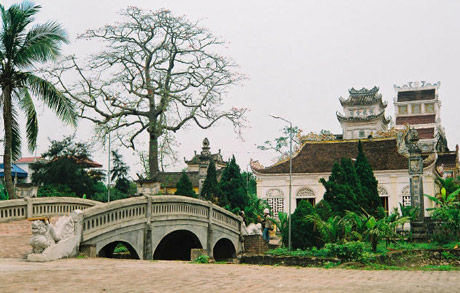
A bridge leads to Phat Giao Hoi Quan, a Buddhist
meeting place, built in 1936. In addition to this bridge, the main pagoda can
be reached by two other bridges in the mountains. In the center of the pagoda
is a large 9,000-kg bell moulded in 1936. In the upper temple is the statue
of Thich Ca Buddha; it is made of red lacquer trimmed with gold.
Several rare relics, such as a great red bell and
bronze drums dating from the Ly dynasty, are kept in this pagoda.
Vieng Market
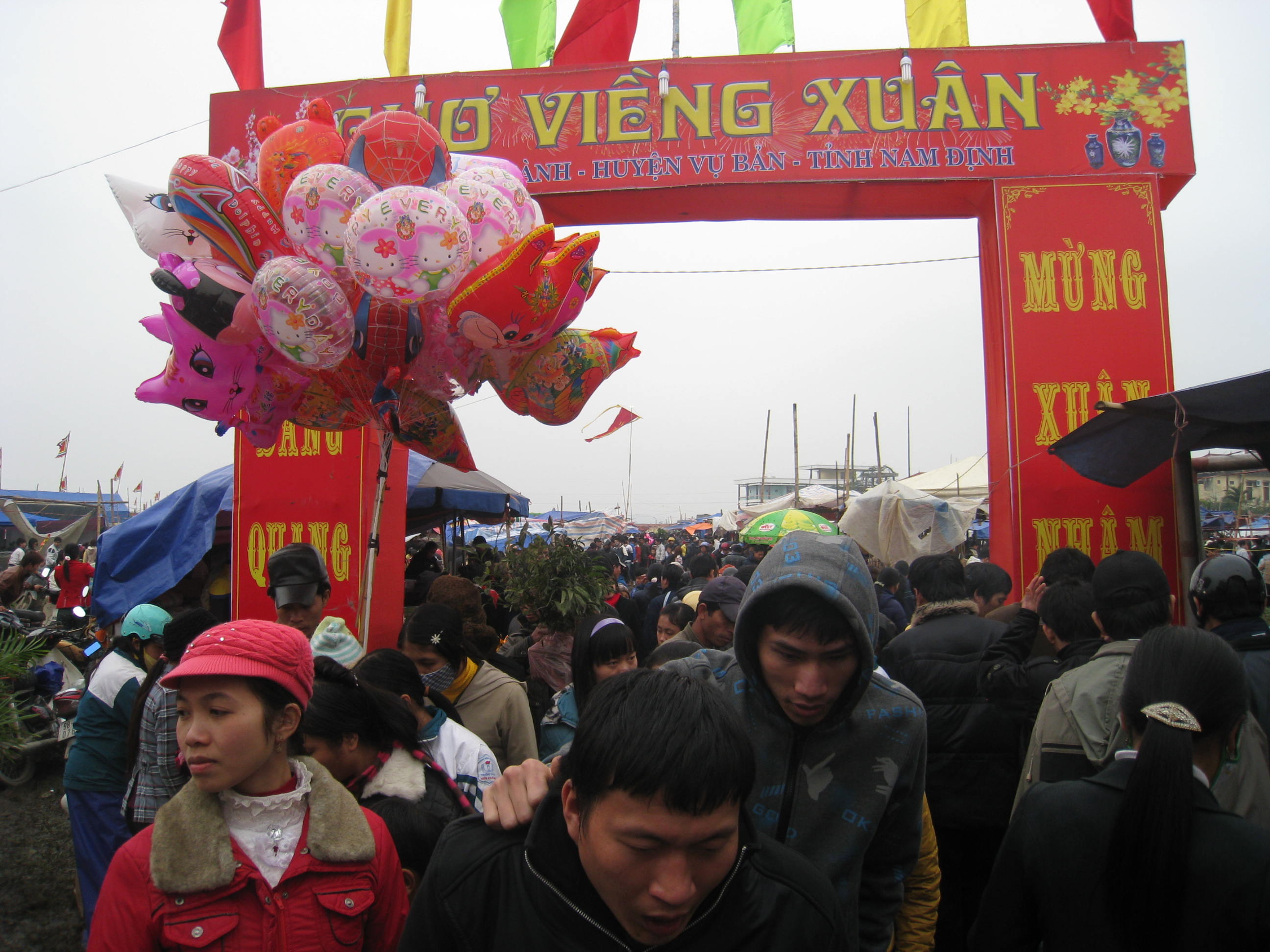
Held in Nam Truc and Vu Ban Districts, Nam Dinh
Province, Vieng market festival is launched on the annual 8th day of the
first lunar month, only once a year, just after Tet (Lunar New Year) holiday.
This is one of the most famous traditional market festivals in Vietnam.
Legend has it that Vieng market is linked to the person
who brought copper casting to the area, Nguyen Minh Khong, so people who go
the market feel that they will get lucky if they buy something made of copper
on this day.

The market opens on the 8th of lunar January;
nevertheless, the most spiritual moment falls on the night of the 7th and
early 8th. That is the moment of heavenly-earthly, positive-negative
exchange. According to the popular belief, at the time, men and Gods reach
together and prayers could be perceived more clearly. Trade at the time takes
place smoothly. Consequently, there are 40,000-50,000 people coming to the
market on the night of 7th.
The market on the night of 7th is called “Cho am phu”
(Hades Market). There are about 10,000-12,000 people coming to the market on
the following 8th. The market-goers not only enjoy the atmosphere but also
bring along the feeling toward Mother, praying for fortune and favorable
nature, rich crops, and happy family. They buy and sell for luck in the rest
of the year.

Vieng market is typical to an agricultural countryside
that is rich in natural products, a kind of radiant open-air “fair” produced
by local farmers, especially ornamental plants, specialty crops, subtle craft
articles, utensils, bronze and iron-made tools, etc. This spring market
displays handicraft products, antiquities and false antiquities, utensils,
tools for agriculture production, and many kinds of ornamental plants.
Specialties are barbecued beef and “banh day” (sticky rice cake).
The cheapest things at Vieng would be flowers and
trees, which bring both the buyer and seller happiness and luck. From around
2a.m, deals are done under the light of candles or flash-lights. Deals are
agreed to quickly, as people believe, to keep luck. From 6a.m, local people
bring farming tools such as hoes and sickles to sell, which relate closely to
their lives. Buyers believe that the tools will bring them health and riches.
Vieng market also is also a place to relax. Lovers would find themselves or
their happy future here.

Above all, everyone visiting the market wants to buy
the burnt veal at any cost, which is considered the indispensable gift from the
market from the fair of the Vieng market-goers. Vu Ban people think of
folk-songs as a reminder:
Beautiful churches
(1).jpg)
Diocese of Bui Chu
Nam Dinh is home to many beautiful Roman
Catholicchurches.
Diocese of Bui Chu: Located in
Xuan Ngoc commune, Xuan Truong district, the church was built in 1885. After
more than 100 years, the Diocese of Bui Chu is still majestic and
superficial. With a length of 78m, a width of 22m and 15m high, this church
hosts many important events.
The diocese is reportedly Vietnam’s first place where
Catholicism was introduced by foreign missionaries in 1533. It is also the
cradle of Catholicism in the country. French Bishop Pierre Lambert de la
Motte, one of the first two bishops of the Catholic Church in Vietnam,
founded the first indigenous congregation of Adorers of the Holy Cross in the
diocese in 1670.
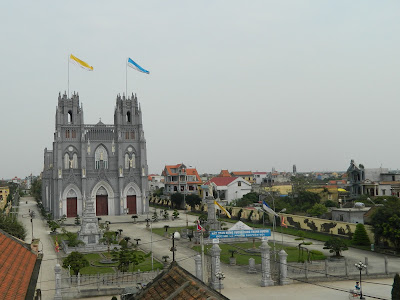
Phu Nhai church
Phu Nhai Church: The church, located in Xuan Phuong
Commune, Xuan Truong District, was first built in 1866 as a small temple, but
was later renovated and expanded. It is considered the biggest church of
Gothic architecture in Vietnam, with 30m height, 28m width and 80m length.
There are 2 bell towers with 44m height, containing 4 bells. It has statues
stuck on the surface of the walls or the doors.

Kien Lao church
Kien Lao Church is located in Xuan Tien commune,
Xuan Truong district with a length of 75m, 26m wide, 28m high and a 46m high
bell tower. On the two sides of the church are lakes and rows of street
lights.
Trung Linh Church is located in Xuan Ngoc commune,
Xuan Truong district, 1.5 km from the Diocese of Bui Chu. This church was
built in 1928 and is very beautiful. This is one of the favorite places of
couples to take wedding photos.
Thanh Danh Parish: The church
is in Xuan Trung commune, Xuan Truong district. It is famous for carved
murals related to the classic reference in the Bible.

Thanh Danh Parish
Nam Dinh Cathedral is located in the heart of Nam Dinh
City. The church has a simple design but still exudes serious contemplation.
Hung Nghia Church: This
church looks like a castle with fine details. This church is located in Hai
Hung commune, Hai Hau district, built in 1927 and renovated in 2000.
Xuong Dien Church: The church
is located in the coastal commune of Giao Thuy, Hai Hau province, with tile
roofs and wood frame like Buddhist temples in Vietnam. The combination of
European-Asian style is familiar to Vietnamese.

Hung Nghia church
An Phu Church: This church is in Bui Chu
parish, with quite distinctive architecture. Through the ups and downs of
history, wars, and weather, the church fell into disrepair and it was rebuilt
in 2007.
Hai Ly ruined church: Although
it is seriously damaged, the church on the coast of Hai Ly commune, Hai Hau
district is still one of the favorite destinations of tourists.
In the past, the coast of Xuong Dien in Hai Ly commune,
Hai Hau district had many large and small churches.

However, over time, seawater encroached on the coast
and damaged these churches. Parishioners moved the church deep into the
mainland three times to avoid the "invasion" of the sea.
The damaged church on the coast of Xuong Dien named
Trai Tim (Heart) has been abandoned since 1996.
The best time to take photos of the church is around
5am or 6pm.
Compiled by Pha Le, VNN
|
Thứ Hai, 7 tháng 11, 2016

Đăng ký:
Đăng Nhận xét (Atom)
Không có nhận xét nào:
Đăng nhận xét