ASEAN countries disadvantaged by poor English skills
English is now the global language of business and the
official language of the ASEAN Economic Community (AEC)— as the regions’
leaders have opted to heed the advice of leaders from multinational
companies.
Multinational companies such as – Tokyo
headquartered Rakuten, Lenovo, Audi, Lufthansa, Daimler-Chrysler, Nokia,
Renault, Samsung, and Microsoft – to name just a few, have mandated English
as their official language.
Adopting a common mode of speech isn’t just a good idea; it’s a must for
any company that wants to be a serious competitive contender in the
international business arena, these business leaders say.
Hiroshi Mikitani, chairman and CEO of Japan's biggest e-retailer,
Rakuten, who is reported by US Forbes magazine as one of the globe’s leading
businessmen having a net worth of US$7 billion, is one of them.
As far back as 2010 he announced the company’s goal was to become the
number one global computer services company and simultaneously mandated
English as the company’s official language.
The dictate affected some 7,100 Japanese employees, he said at the time,
declaring the expanded world view the English language offers as essential to
the company’s long-term success.

Today, Rakuten is the leading challenger to Amazon.com in both the US
and European markets.
Lenovo, headquartered in Brazil, is another one of the growing number of
multinationals from the non-Anglophone world that have made English their
official language, according to the company’s CEO Yang Yuanqing.
He made the decision to adopt English as the official language of the
company in 2005 following the lead of Singapore, a small company with global
ambitions, and today virtually all of the company’s business is conducted in
English.
Audi may use a German phrase - Vorsprung durch Technik, or progress
through engineering – in its advertisements, but it is impossible to progress
through its company’s management ranks without good English.
When Christoph Franz became boss of Lufthansa in 2011 he made English
its official language even though all but a handful of the airline's 50 most
senior managers were German.
There are obvious reasons why multinational companies want a common
language business leaders say – as it makes it easier to recruit top
global talent, reach global markets, assemble global production teams and
integrate foreign acquisitions.
A worldwide study concluded by Canadian Research firm Ipsos in mid-2015
indicated that 25% of all jobs everywhere require employees to interact with
people in other countries, increasing to 50% for many countries in the ASEAN
region.
Of these jobs, two-thirds require employees to communicate fluently in
English, the study concluded.
One reason English is the dominant language of business and of the
Internet is that it is the native language in over more than 60 nations, and
increasingly the official secondary language elsewhere.
While companies in native English-speaking countries are at a distinct
advantage, so are those in countries where English proficiency is high such
as Singapore, Malaysia, Scandinavia, and the Netherlands.
Businesses in other nations such as many in ASEAN where English
proficiency is significantly lower (or virtually non-existent) such as
Vietnam, Thailand and Cambodia-are conversely disadvantaged, the survey
concluded.
VOV
|
Thứ Hai, 4 tháng 1, 2016

Chủ Nhật, 3 tháng 1, 2016
|
HCM City: Thousands
join voluntary blood donation
Thousands of people participated in the “Red Sunday”, a
voluntary blood donation progamme, held in the southern city of Ho Chi Minh
on January 3.
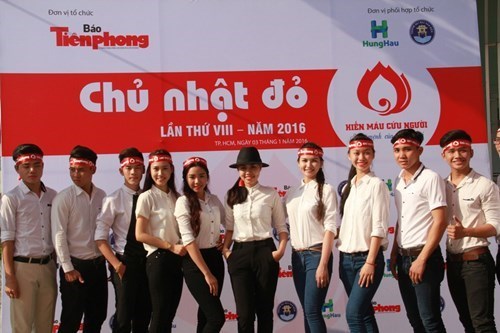
The "Red
Blood" day opens in Ho Chi Minh City (Source : tienphong)
Some 1,000 blood units were collected in the morning of the
day.
Secretary of the Central Committee of the Ho Chi Minh Communist Youth Union Nguyen Anh Tuan said the programme holds a significant meaning in increasing public awareness of sharing precious blood to save patients. After Ho Chi Minh City, the programme will travel to other provinces and cities across the country. The “Red Sunday” was first held in 2009. Taking place nationwide on the New Year occasion, the programme has received warm response from the public, especially young people. The initiative was co-organised by the Tien Phong Newspaper, Ho Chi Minh City Voluntary Blood Donation Centre, Cho Ray Hospital and Van Hien University.- VNA |
|
Hanoi Memories at Thang Long Royal Citadel
A programme recreating life as it was in the past is being held
at Thang Long Royal Citadel in Hanoi.
The event opened
at Thang Long Royal Citadel, UNESCO-recognised world culture heritage,
features unique cultural features of Hanoi.

Visitors can have
a look at old Hanoi city gates, a model of an electric tram, an antique
market, old streets, craft villages and streets and street music
performances. Architecture, bonsai, craft products, Hanoi cuisine, old Hanoi
costumes, folk festivals and flower arrangements are also displayed at the
programme.
The Hanoi Old
Quarter space features recreations of old streets selling their typical
products, with artisans performing their skills and women holding baskets and
standing by bicycles full of flowers.
The programme
which also includes programmes such as blind street music, ceremonial singing
and calligraphy performance will end on January 4.
 
The model of an electric tram

A water stall
 
Old Hanoi between 1980 and 1990.
 
A public hydrant and a bicycle

Lamps in an antique market
  
By Huu Nghi, dtinews.vn
|
Thứ Bảy, 2 tháng 1, 2016
|
Vingroup boss tops Vietnam’s richest list for 6th
straight year

The top ten wealthiest people on Vietnam's stock market is
seen in this photo by VnExpress.
Pham
Nhat Vuong, the first Vietnamese to have more than US$1 billion worth of
assets, remained the richest on Vietnam’s stock market for the sixth
consecutive year in 2015, with his fortune nearly approaching the $1.1
billion mark.
Vuong, chairman of the giant realty developer Vingroup, topped
the “100 richest people on the Vietnamese stock market” list with total
assets of VND24.33 trillion ($1.09 billion), according to data released by
newswire VnExpress on Thursday.
Tran Dinh Long, chairman of Hoa Phat Group, came second with
VND5.38 trillion ($240.18 million) worth of assets, whereas Pham Thu Huong,
deputy chairwoman of Vingroup, ranked third with VND4.19 trillion ($187.05
million).
Doan Nguyen Duc, chairman of Hoang Anh Gia Lai, was eliminated
from the top three for the first time in eight years, as he stood at the
fourth place in the 2015 list, with assets dropping to VND3.61 trillion
($161.16 million) from some VND7.57 trillion ($337.95 million) in early 2015.
Another Vingroup deputy chairwoman, Pham Thuy Hang, completed
the top five with assets worth VND2.8 trillion ($125 million).
The family of Vuong occupied as many as three out of the top
five positions, as Huong is his wife while Hang is his younger sister.
Huong is the first woman to enter the top three richest, with
her assets increasing by more than VND700 billion ($31.25 million) from a
year earlier, according to VnExpress.
The Vingroup boss, in the meantime, was the only Vietnamese
out of the 1,426 billionaires in Forbes' 2013 annual ranking of
billionaires. He stood at #974 on the list with what Forbes estimated to be $1.5 billion worth of assets. The finance
magazine also dubbed him the first billionaire of Vietnam.
The total assets of 100 wealthiest people in Vietnam’s stock
market in 2015 were nearly VND83.65 trillion ($3.7 billion), up 2.6 percent
from the 2014 list, according to VnExpress.
At the last session of 2015, Vietnam's benchmark VN Index rose
6.3 percent year on year, whereas the HNX Index on the Hanoi Stock Exchange
fell 3.3 percent, which illustrates the market fluctuation that has greatly
affected assets of investors and businesses over the year.
The 2015 list of the 100 richest people in the Vietnamese
stock market is the tenth of its kind to be compiled by the VNDIRECT
Securities Corporation and released by VnExpress.
VNDIRECT said the data is gathered from publicized information
of nearly 700 businesses listed on the stock exchanges in the Hanoi and Ho
Chi Minh City stock exchanges.
Below is the top ten wealthiest people in Vietnam’s stock
market.
 Data compiled by VNDTUOI TRE NEWSIRECT Securities Corp
TUOI
TRE NEWS
|
|
New Year's Eve crowds destroy
flower gardens in central Hanoi
Thousands
of people trod on public flower gardens around the Sword Lake in Hanoi in
search of good watching spots for the New Year's Eve fireworks show, turning
an area of more than a thousand square meters into something of a wasteland.
Authorities said the damage was worth
around several hundred million dongs, adding that this happened every year.
"The flowers were planted for the
New Year celebration," said a spokesperson of Udic, the contractor
responsible for taking care of the plants. "A group of guards tried to
ask the visitors not to step on the plants but there were thousands of
people."
"Every big holiday, people would
gather and destroy and even steal the plants," he said.
“I couldn't believe what I was
seeing," said a worker of Udic on Friday. "Last time I checked the
flowers were still there and beautiful. Then around 6 a.m. the next morning,
when I began my shift, there's nothing left."
Professor Ngo Duc Thinh of the Culture
Institute said such an destructive act is a "chronic disease."
“There are two main reasons. First,
there's a lack of community awareness. People can keep their house clean, but
they have no problem throwing their trash outside,” said Thinh.
“And second, many prefer shortcuts. They
don’t want to walk around and if walking on flower gardens can help them move
faster, they will do it."

A few flower plants are left behind after thousands of visitors flocked to the Sword Lake for the New Year's Eve fireworks show and destroyed most of the gardens. Photos: Thuy Hang

Visitors tread on the plants around the Sword Lake.

Workers replant flowers around the lake on January 1.
|
|
Vietnam could beat China on GDP growth in 2016: expert

Dr.
Nguyen Xuan Thanh, director of the Fulbright Economics Teaching Program
speaks during an interview with Tuoi Tre (Youth) newspaper in Ho Chi Minh
City.
Vietnam’s economy has the chance to expand at a faster pace than
that of China in 2016, and what matters is whether the country can grab the
opportunity, an economist has said.
A stronger growth than China’s will also enable Vietnam to
become East Asia and Southeast Asia’s fastest-growing economy, Dr. Nguyen
Xuan Thanh, director of the Fulbright Economics Teaching Program in Ho Chi
Minh City, told Tuoi
Tre (Youth)
newspaper in an interview published Saturday.
Vietnam posted a GDP growth of 6.68 percent in 2015, whereas China's economic
growth is expected to cool from 7.3 percent in 2014 to 6.9 percent in 2015,
its slowest pace in 25 years, according to the Chinese central bank.
“Vietnam is approaching near China on GDP growth, and the
chance is the Chinese economy is also forecast to grow slower in 2016,” Thanh
said.
China’s growth could ease further to 6.8 percent or 6.3
percent in 2016, according to respective forecasts by its central bank and
Oxford Economics.
Thanh said China’s growth this year could be only 6.4 percent,
and many regional countries will be affected by the slowing Chinese economy,
except for Vietnam.
“[We] have recently signed many free trade pacts, which are
all going to take effect, and these trade accords will be great stepping
stones for further economic growth if we know how to take advantage of them,”
he elaborated.
“In 2016 if Vietnam continues to be able to stabilize its
macro-economy, the GDP can grow by 6.8-7 percent, which will enable the
country to beat China on GDP growth for the first time since 1986.”
Vietnam sets a GDP growth goal of 6.7 percent for 2016, according to a resolution
approved by the lawmaking National Assembly in November 2015.
Thanh also expressed his belief that Vietnam will be able to
maintain such a healthy economic growth for the next five years, if it can
improve confidence of consumers and resolve difficulties of businesses.
“But in the longer term, Vietnam still has to launch a reform
of economic institutions and economic restructuring to ensure a sustainable
growth,” he noted.
In 2015, Vietnam signed four significant trade pacts, which
all help expand the country’s export markets.
The deals include the Trans-Pacific
Partnership (TPP) agreement with the U.S. and
ten other nations in the Pacific Rim, the free trade agreement with the
Russia-led Eurasian
Economic Union, and the trade accords with the Europe
Union and South
Korea.
The trade pact between Vietnam and South Korea came into
effecton December 20, whereas both the trade deals
with the EEU and EU are scheduled for implementation in 2018.
The TPP, meanwhile, is pending ratification by 12 member
nations before entering into force. The process is expected to begin in Vietnam
in mid-2016.
Thanh said such deals will help the country attract more
foreign investment, both direct and indirect, in 2016.
“The improved global economy in 2016 will also leave positive
impacts on Vietnam,” he added.
Local businesses, particularly those operating in the
manufacturing and production industries, will also have a chance to cut input
costs if oil prices, as well as steel, food and other metal prices, remain
low as in 2015, according to the economic expert.
However, Vietnam will still have to face several challenges in
2016, especially in the respect of banking, forex management and real-estate,
he warned.
While Vietnam has exerted efforts to restructure the banking
sector, what it has done so far is being able to ensure stable liquidity in a
short term, Thanh said.
“Weak banks remain the biggest risk for the economy this year,
and it is not likely that lending interest rates will be cut,” he elaborated.
TUOI TRE NEWS
|
ASEAN goes far beyond Summits

Illustrative
image (Source: linkedin)
Hanoi - Its summits and ministerial
meetings get a lot of media coverage, but ASEAN’s engagement with its
stakeholders, partners and constituencies goes far beyond official venues.
For
example, the ASEAN Foundation was created during ASEAN’s 30th anniversary in
1997 with the t win objectives of promoting greater awareness about ASEAN,
greater interaction among the peoples of ASEAN and their participation in ASEAN
activities; as well as contribute to the evolution of a development cooperation
strategy that promotes mutual assistance, equitable economic development, and
poverty alleviation.
Called ‘the people’s arm of ASEAN’ and mandated by the ASEAN Charter to support the ASEAN Secretary-General in the community building process, the ASEAN Foundation’s range of activities includes organising and promoting education, training in science and technology, health and culture by providing fellowships to and supporting exchanges of ASEAN youth and students, and promoting collaborative work among academics, professionals and scientists. Among the Foundation’s programmes is the ‘Model ASEAN Meeting’, an interactive process where students and young people role-play as ASEAN senior officials in an ASEAN meeting as part of an interesting and enjoyable learning experience. The first Model ASEAN Meeting was held in Kuala Lumpur in tandem with the 27th Summit in November 2015. Also enshrined in the ASEAN Charter is the creation of an ASEAN human rights body, which was established as the ASEAN Intergovernmental Commission on Human Rights (AICHR) in 2009. It is the first sub-regional human rights institution in the Asia-Pacific. The Commission played a key role in the drafting of the ASEAN Human Rights Declaration and the Phnom Penh Statement on the Adoption of the AHRD, which ASEAN Leaders approved in 2012 as a framework for human rights cooperation and a mechanism to mainstream human rights in all three pillars of the ASEAN Community. Apart from the ASEAN Foundation and the AICHR, which are provided for in the ASEAN Charter, there also exists a diverse group of organisations accredited as “entities associated with ASEAN” that are to support the purposes and principles of the Charter. These entities may be involved in ASEAN-related dialogues, consultations, seminars, workshops and fora. There are 78 associated entities at present, consisting of parliamentarians, business organisations, think tanks and academic institutions, accredited civil society organisations and other stakeholders in ASEAN. For instance, the ASEAN Inter-Parliamentary Assembly consists of parliamentarians or members of legislative assemblies in ASEAN Member States. There are currently 19 business organisations classified as entities associated with ASEAN, coming from sectors such as airlines, banking, textile, tourism and shipping. Examples include the ASEAN Business Advisory Council, ASEAN Bankers’ Association, and ASEAN International Airports Association. Two think tanks or academic institutions are among the ASEAN associated entities that provide analyses and venues for the discussion of various strategic issues. These are the ASEAN-Institute of Strategic and International Studies Network in the region, and the ASEAN Institute for Peace and Reconciliation. There are 52 civil society organisations accredited to ASEAN as of November 2015. They include the AirAsia Foundation, ASEAN Confederation of Employers, ASEAN Fisheries Association, A SE A N Football Federation, ASEAN Law Association, ASEAN Music Industry Association, and Southeast Asia n Studies Regional Exchange Program Foundation. Finally, there are four groups classified as ‘other stakeholders in ASEAN’, which include the ASEAN Supreme Audit Institutions, Federation of Institutes of Food Science and Technology in ASEAN, Southeast Asian Fisheries Development Centre and the Working Group for an ASEAN Human Rights Mechanism. Regardless of which sector they focus on, these organisations and entities associated with ASE A N share a common objective in complementing ASEAN’s Community-building efforts, and contributing to a deepened sense of a shared ASEAN identity. ASEAN invites other organisations and entities in the region to explore opportunities to associate with ASEAN, and contribute to the strengthening of the ASEAN Community beyond 2015.-VNA |
Đăng ký:
Nhận xét (Atom)