|
BUSINESS NEWS IN BRIEF 2/8
Can Tho
invites investors to investment promotion conference
The Mekong Delta city of Can Tho will hold an
investment promotion conference on August 10, inviting investors for 54
projects worth nearly 124 trillion VND (5.44 billion USD).
At a press conference on the conference on August 1,
Chairman of the municipal People’s Committee Vo Thanh Thong said investors
have already expressed interest in 44 out of the 54 projects on offer, and
some are ready to start work immediately on 22 projects.
He added that some projects attracted two or more
investors, so the city will set criteria to select the best among them.
Among the 54 projects, 21 are in real estate, 9 in
culture-sports and tourism, 9 in agricultural and industrial infrastructure,
8 in transport, 4 in logistics and power, 2 in cultural-sport and health care
infrastructure and 1 in information technology.
Prime Minister Nguyen Xuan Phuc is expected to deliver
a keynote speech and chair the conference, which will include three
discussions on a logistics service centre, hi-tech agriculture and the
development of science-technology.
Chairman Thong said the city wants to use the event to
introduce to investors its potential and favourable conditions along with
opportunities in the context of the new specific mechanism for the city
already approved by the National Assembly Standing Committee.
Can Tho also hopes to invite investors to other
projects and fields besides those announced at the conference, he said.
At the conference’s closing session, the city will
honour 11 companies which have made contributions to Can Tho’s development, and
present investment licences and decisions approving investment proposal to 10
investors.
On the occasion, the municipal People’s Committee will
sign cooperative deals with around 20 foreign and domestic corporations.
PVN signs trade agreements on gas field
exploitation
Viet Nam National Oil and Gas Group (PetroVietnam) on
July 31 signed a number of trade agreements on exploiting the Sao Vang - Dai
Nguyet project.
The agreements included gas sales purchase agreement;
an agreement on connection and services; and gas sales agreement of the Sao
Vang - Dai Nguyet gas project, blocks 05-1B and 05-1C.
The stakeholder participation in the Petroleum Sharing
Contract (PSC) includes Idemitsu Kosan Co Ltd with 43.08 per cent and the
operator; Teikoku Oil (Con Son) Co Ltd, 36.92 per cent; and PetroVietnam, 20
per cent.
Speaking at the signing ceremony, PVN’s general
director Nguyen Vu Truong Son said the signing of trade agreements to exploit
oil and gas fields is very significant. The production of oil and gas from
Sao Vang - Dai Nguyet field will contribute to the supply of gas for the
country’s economic development, especially the socio-economic development of
the southeast region.
Sao Vang - Dai Nguyet gas field is located in Nam Con
Son Basin, approximately 300km south-east offshore Vung Tau City at about
110-130m water depth.
The success of the Sao Vang - Dai Nguyet gas project
will compensate for the shortage of gas as the other gas fields have reduced
production; and play an important part in securing the country’s energy, Son
emphasised.
Prior to this, on August 4, 2016, the Prime Minister
issued Decision No 1550/QD-TTg approving petroleum reserves of Sao Vang - Dai
Nguyet field, as the basis for the development of the field.
On March 7, 2017, the Ministry of Industry and Trade
issued Decision No.706/QD-BCT approving the outline development plan.
Nine months later, the Prime Minister issued Decision
No 1996/QD-TTg approving the field development plan. Accordingly, Sao Vang -
Dai Nguyet field is expected to start exploiting the first oil and gas line
for trade in the third quarter of 2020 with an estimated output of 1.5
billion cu.m of gas per year and 2.8 million barrels of crude oil and
condensate per year.
Dong Nai’s export surplus half of country’s total
Dong Nai’s export surplus in the first seven months of
the year was US$1.6 billion, which made up half of the country’s total.
Dong Nai is among the country’s top five exporting
cities and provinces, with a consistently high export surplus, according to
the province’s Department of Industry and Trade.
The province has around 50 products with high export
turnover, including textiles and garments, footwear, wooden products, and
steel, exported to around 170 countries and territories. The products are highly
regarded by foreign businesses.
According to the Statistics Office of Dong Nai, it
exported around $9.2 billion worth of goods in the first seven months, 14 per
cent higher year-on-year and its highest in four years.
Eighty per cent of Dong Nai’s export turnover is from
foreign-direct invested companies in the province.
According to the General Statistics Office (GSO), Viet
Nam gained a trade surplus of $3.1 billion in the first seven months of this
year.
This is because its total export value during the first
seven months rose 15.3 per cent year-on-year to $133.7 billion.
Of which, the domestic economic sector’s export value
increased 18.7 per cent to $39.3 billion over the same period of last year
while that of foreign invested enterprises had a growth of 14 per cent to
$94.7 billion, accounting for 70.8 per cent of the total export value.
Meanwhile, the nation saw slower growth in imports with
the total import value in the first seven months of this year rising 10.2 per
cent to $130.6 billion against the same period of last year.
The import value rose 12.7 per cent to $54.2 billion
for the domestic economic sector and 8.5 per cent to $76.5 billion for the
foreign invested enterprises.
However, GSO experts said from May to July, the nation
had trade deficit in each month. The trade deficit was $500 million in May,
$100 million in June and $300 million in July.
Viet Nam had large trade deficit with China and South
Korea. In the first seven months of this year, the trade deficit was at $16.3
billion with China, up 1.6 per cent year-on-year, and at $16.3 billion with
South Korea, which was down 13 per cent.
The GSO reported major export products continued to
achieve strong increases, in particular telephone and parts with a growth of
15.8 per cent to $26.1 billion; textile and garment, up 16.2 per cent to
$16.5 billion; and electronic products, computer and parts, up 14.8 per cent
to $15.7 billion.
They also included footwear, up 8.9 per cent to $9.1
billion; machine, equipment and parts, up 27.1 per cent to $9 billion; wood
and wooden products, up 13.4 per cent to $4.8 billion; and transport means
and parts, up 15.2 per cent to $6.4 billion.
The nation saw growth in export value for some agro and
seafood products (up 8.1 per cent to $4.7 billion), vegetables and fruits (up
14.6 per cent to $2.3 billion), and rice (up 31.5 per cent to $2 billion).
However, reduction in the global export prices drove
export value down for some farming products of Viet Nam, such as coffee (down
4.5 per cent to $2.2 billion), and rubber (down 9.7 per cent to $1 billion).
Crude oil export dropped in both volume and value by
46.4 per cent and 25.3 per cent to $1.3 billion, respectively.
Economic growth reduces dependence on bank loans
Though credit growth has declined recently, Viet Nam’s
GDP has continued to rise in the past one and a half years thanks to the
improvement of credit quality and the contribution of foreign direct
investment (FDI) firms.
A few years ago, Viet Nam’s economic growth was mainly
based on capital and labour due to modest total factor productivity (TFP).
This meant that the nation’s high GDP growth required high investment, and
loans had a domino effect on the country’s growth.
There was time when credit growth was even used to
estimate the country’s economic growth. For example, bank loans often
increased by 1.5 times or two times over GDP growth.
However, dependence has reduced significantly recently
and credit is no longer the decisive factor for the country’s economic
growth.
According to the National Financial Supervisory
Commission, GDP in the first half of 2018 grew at 7.08 per cent against the
same period last year, the highest rate in eight years, while credit growth
in the period expanded only about 6.5 per cent, much lower than the same
period last year of 8.7 per cent.
The same trend was also seen last year when credit grew
at only 18.17 per cent, lower than the increase of 18.71 per cent in 2016,
while GDP growth was 6.81 per cent, higher than the growth of the years from
2011 to 2016.
Experts attributed the positive change to the
improvement of credit quality.
According to the State Bank of Viet Nam (SBV), credit
structure in the first six months of 2018 focused mainly on manufacturing (up
7.7 per cent), agriculture (up 7.2 per cent), small- and medium-sized
enterprises (up over 3 per cent).
Meanwhile, credit for risky areas such as securities
and real estate industries was small. Credit flowed mainly to manufacturing
sectors to contribute to GDP growth rather than focusing on speculative
sectors like real estate or stock markets as years ago.
Besides, the dependence of GDP growth on credit has been
declining due to the contribution of the FDI sector to the economy.
In the first six months of 2018, the industrial sector
was the best performer with an increase of 9.28 per cent, of which processing
and manufacturing had a growth rate of up to 13.02 per cent, the highest rate
in seven years. Meanwhile, most FDI firms didn’t borrow or borrow overseas
loans, hence, though production and business grew, the country’s credit
growth was not directly affected.
SCG announces 20 per cent surge in sales
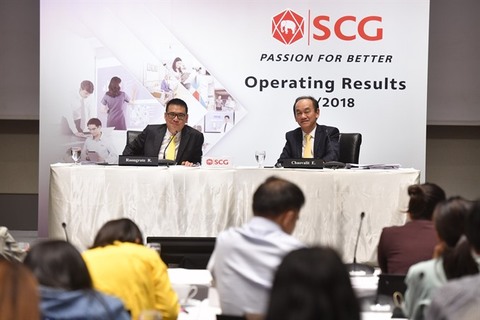
Thai company SCG
has reported a jump in first half revenues to $639 million.
SCG Vietnam has reported revenues of US$639 million in
the first half of this year, a 20 per cent year-on-year jump.
In the second quarter, revenues had risen by an even
more impressive 28 per cent to $371 million, the Thai company said.
SCG has a presence around Southeast Asia, with its
three core businesses being cement and building materials, chemicals and
packaging.
It has more than 200 companies in its group and
approximately 57,000 employees.
It came to Viet Nam in 1992 as a trading business and
has gradually diversified into cement, building materials, petrochemicals,
and packaging.
It recently bought Vietnam Oil and Gas Group (Petro
Vietnam)’s 29 per cent stake in Long Son Petrochemicals, in which it holds
the remaining 71 per cent, and is scheduled to sign a $3.2 billion loan deal
with local and international financial institutions in August.
The project’s engineering, procurement, and
construction phase will start this quarter, and it is scheduled to go on
stream by the first quarter of 2023.
VinFast to open offices in Europe, Asia
VinFast Trading and Production Limited Liability
Company, a member of the property developer Vingroup, has just finished
procedures to open an office in Frankfurt, Germany.
According to VinFast, the business registration office
of Frankfurt has issued a certificate of establishment of VinFast GmbH (Limited
Liability Company) operating in the field of purchasing, selling,
distributing and performing commercial transactions (including but not
limited to import and export) on spare parts, components and materials for
the automotive and related services industries.
After cooperation with a number of German partners such
as BMW, Siemens, Bosch, Durr AG, Schuler AG, Eisenmann, FFT and EBZ, the
establishment of VinFast GmbH in Frankfurt reaffirms VinFast’s commitment to
producing world class and high quality vehicles.
In addition to Germany, VinFast is also completing
final procedures to establish subsidiaries in Shanghai, China and the
Republic of Korea.
VinFast’s establishment of subsidiaries in major
automobile manufacturing and consumption centres in Europe and Asia is the
next step to enter the world’s automotive market, expressing the global
vision of the Vietnamese car brand.
Technically, this step will allow VinFast to easily
access the most modern automotive manufacturing technologies and leading
suppliers through partners in these countries.
In terms of product research and development,
establishing a presence in Germany, the Republic of Korea and China will
create favourable conditions for VinFast to keep up with the latest trends in
the global automobile industry.
As regards to the market, VinFast’s offices will play a
significant role in understanding consumer tastes in different regions of
both continents, to export VinFast cars outside of the country.
Registered capital of new firms up 11.6 percent
Nearly 75,800 new enterprises were established
nationwide in the first seven months of the year, with a total registered
capital of 771 trillion VND (33.34 billion USD), a year-on-year rise of 3.9
percent in the number of firms, and a 11.6-percent rise in terms of capital,
according to the General Statistics Office (GSO) of Vietnam.
At the same time, more than 1,460 trillion VND (62.78
billion USD) was injected into operating firms, raising the total registered
capital pumped into the economy to over 2,231 trillion VND (95.83 billion
USD).
The office said of the newly-established firms, 25,700
are in the wholesale and retail, and automobile and motorbike maintenance and
repair industries, accounting for 33.9 percent of the total. This was
followed by the construction sector with 10,000 firms (13.3 percent of the
total), and processing and manufacturing with 9,400 companies (12.4 percent
of the total). There are 5,700 firms operating in science-technology,
consultancy, design, advertisement and others (7.6 percent).
Regions nationwide witnessed an increase in the number
of newly-established firms, with the Red River Delta host to 22,600 new
companies (up 1.2 percent year-on-year), the midland and northern mountainous
regions with 3,200 firms (2.8 percent), the north central and central coastal
regions with 10,700 firms (7.4 percent), southeast regions with 32,100 firms
(5 percent), and the Mekong Delta region with 5,400 firms (4.4 percent).
The total number of workers at new companies was
623,000, down 13.5 percent against last year’s January-July period.
During the reviewed period, 18,696 companies resumed
their operations, up 6.5 percent from the same time last year.
In addition, the number of businesses that ceased
operations rose by 38.4 percent to 59,910 enterprises.
Meanwhile, there were 7,714 firms who completed
dissolving procedures, up 16.7 percent year on year. Most of them were
operating in wholesale and retail, automobile and motorbike repairing
industries (3,000 firms), processing and manufacturing (1,100 firms), and
construction (792 firms).
According to GSO General Director Nguyen Bich Lam, a
flexible monetary policy, with a focus on prioritised sectors for small- and
medium-sized enterprises (SMEs) and export firms, is a must in order to
improve the operating efficiency of firms.
In addition, the Government should continue to create a
favourable business climate for companies, paying due attention to developing
the processing and manufacturing sectors, supportive industry, and production
of consumption goods, he added.
Agro-forestry-fishery exports hit 22.2 billion USD in
first seven months
The export turnover of agro-forestry-fishery products
in July was estimated at 2.85 billion USD, bringing the total value in the
first seven months of 2018 to 22.2 billion USD, a year-on-year rise of 7.8
percent.
According to the Processing and Market Development
Authority (AgroTrade) under the Ministry of Agriculture and Rural
Development, Vietnam exported 11.6 billion USD worth of farm produce from
January to July, up 3.6 percent against the same period last year.
Markets seeing strong export growth included Indonesia
in rice, coffee, and rubber; Russia in coffee and cashew nuts; Germany in
tea, cashew nuts, pepper, and rubber; Malaysia in rice, tea, wood, vegetables
and fruit; the Philippines in rice and coffee; Saudi Arabia in tea; Iraq and
Hong Kong in rice; the US in tea, cashew nuts, and pepper; India in rubber
and pepper; and Thailand in vegetables and fruit, and aquatic products.
Rice remained one of the biggest hard currency earners.
Vietnam earned 1.96 billion USD from selling 3.87 million tonnes of rice
abroad, up 29.2 percent in value and 12.2 percent in volume. China continued
to be the largest rice importer of Vietnam with 26.8 percent of the market share.
In the seven-month period, Vietnam earned 2.3 billion
USD from exporting fruits and vegetables, mainly to China, up 12.6 percent.
The country exported 1.16 million tonnes of coffee
worth 2.22 billion USD, up 10.8 percent in volume but down 5.7 percent in
value. Germany and the US remained the two biggest consumers of Vietnamese
coffee.
Vietnam sold 153,000 tonnes of pepper worth 517 million
USD to overseas markets during the January-July period, up 3.7 percent in
volume but down 36.1 percent in value.
As many as 696,000 tonnes of rubber were exported in
the period, bringing home 997 million USD, up 9.9 percent in volume and down
10.7 percent in value.
Vietnam posts trade surplus of US$3.1 billion in first
seven months
Vietnam registered a trade surplus of US$3.1 billion in
the first seven months of 2018, according to the General Statistics Office
(GSO).
Exports during the period were estimated at US$133.69
billion, up 15.3% annually, while imports were valued at US$130.63 billion,
up 12.7% over the same period of 2017.
The first seven months of 2018 saw domestic enterprises
record a trade deficit of US$15.1 billion, while the foreign-invested sector,
including crude oil revenues, ran a surplus of US$18.2 billion.
Foreign enterprises remained the main export driver of
the Vietnamese economy, accounting for 70.8% of the country’s total export
revenues during the January-July period.
A breakdown of the export markets shows that the US was
the largest buyer of Vietnamese goods with US$25.5 billion, up 8.9%, followed
by the EU and China, with their imports from Vietnam worth US$24.2 billion
and US$19.5 billion respectively.
Exports to the ASEAN market also recorded strong growth
at 16.2% to US$14.2 billion, while exports to the Republic of Korea surged by
32% to reach US$10.2 billion.
On the other side, China remained the largest source of
Vietnam’s imports with US$35.8 billion. The Republic of Korea came second
with US$26.5 billion and ASEAN third with US$18.1 billion.
Medical expo next month in HCMC
The 18th International Medical, Hospital &
Pharmaceutical Exhibition (Vietnam Medi Pharm Expo) slated to take place in
HCM City from August 2 to 4 promises to showcase new products and
technologies.
This year the expo has attracted 350 companies from 20
countries and territories, 20 per cent more than last year.
The major exhibitors will be from India, South Korea,
Malaysia, Japan, China, Iran, Ukraine, Russia, the US, Italy, Germany, and
Singapore.
They will display consumables; equipment for
laboratories, dentistry, ophthalmology measurement and testing, endoscopy,
operating rooms, and homes; pharmaceutical machinery; and drugs and food
supplements.
At the event, the Private Medical Practice Group of HCM
City, the Family Physicians Association of HCM City and the Diabetes and
Endocrinology Association of HCM City will organise seminars on diabetes.
The expo, to be held at the Sai Gon Exhibition &
Convention Centre in District 7 by the Viet Nam National Trade Fair and
Advertising JSC (Vinexad) and the HCM City Medical Equipment Association.
Provinces to host farm produce fairs
A fair showcasing products of communes as well as
hi-tech farm produce in the northern midland and mountainous region will be
held this month in the northern province of Thai Nguyen.
The ‘One commune one product (OCOP)’ fair aims to
honour Viet Nam’s high-quality agro-forestry-fisheries products which are
well-known in domestic and foreign markets, organisers said a press
conference in Ha Noi on Tuesday.
Nguyen Quoc Huy, Deputy Director of Thai Nguyen
Department of Industry and Trade, described the forthcoming event as a good
chance for cities and provinces in the region to advertise their potential
and strengths in agriculture and green tourism.
The fair, organised annually by Thai Nguyen province
since 2016, will also offer a venue for businesses, farms and processors to
exchange experience and set up partnerships, he said. The event will run from
August 31 to September 6.
Also at the press conference, the People’s Committee of
Binh Dinh Province announced that it will host a fair displaying farm
produce, seafood and timber goods from the south central coastal region from
August 1-6.
The upcoming event will contribute to promoting trade,
as well as supporting and boosting agricultural production in a
comprehensive, modern and sustainable manner, said Dao Van Ho, Director of
the Trade Promotion Centre for Agriculture under the Ministry of Agriculture
and Rural Development (MARD).
In particular, advanced technologies in agricultural
production, aquaculture and offshore fishing, preservation, processing and
environmental treatment will be showcased, he added.
Statistics from MARD revealed that the national export
value of agriculture, forestry and seafood products in the first half this
year marked an increase of 12 per cent over the same period last year,
reaching US$19.4 billion.
Of this, the export value rose by 9.7 per cent for
agricultural products to reach $10.3 billion, by 10.5 per cent for seafood
products to $3.94 billion and by 12.7 per cent for main forestry products to
$4.33 billion compared to the same period last year.
Cloud software provider Nutanix enters Vietnamese
market
US-based cloud computing company, Nutanix, is now
present in Viet Nam to support business growth with its leading
hyper-converged infrastructure solutions, including 100 per cent
software-based and multi-cloud management technologies.
Hyper-converged infrastructure streamlines the
deployment, management and scaling of datacentre resources by combining
server and storage resources with intelligent software. Separate servers,
storage networks and storage arrays can be replaced with a single
hyper-converged solution.
The Nutanix Enterprise Cloud OS enables enterprises to
simplify infrastructure for a better focus on delivering business values and
innovation. Integrated data protection, non-disruptive upgrades and
self-healing systems ensure predictable performance, reliable disaster
recovery and efficient operations at lower cost.
Some of the world’s most advanced datacentres rely on
Nutanix Enterprise Cloud OS software to power their applications and
services. In Viet Nam, tens of leading enterprises across different
industries have chosen Nutanix.
According to Gartner, an advisory firm, hyper-converged
integrated systems will be the fastest-growing segment of the integrated
systems market, reaching almost US$5 billion, which is 24 per cent of the
market, by 2019.
PVTex, APH sign contract to process yarn
The Petrovietnam Petrochemical and Textile Fiber
Joint-Stock Company (PVTex) with An Phat Holdings JSC (APH) and An Son
Textile Fiber JSC on Tuesday signed a contract to process drawn textured yarn
(DTY) made by Dinh Vu polyester fibre plant.
This signing event was held to launch the DTY spinning
lines for the filament factory at the Dinh Vu polyester fibre plant. The goal
is to have all of these lines operating by the end of the fourth quarter.
PVTex and APH signed a memorandum of co-operation on
producing and trading Dinh Vu polyester fibre on April 27.
This is one of 12 loss-making projects under the
Ministry of Industry and Trade.
The operation of the DTY spinning line resumed in April
this year. After three months, the production lines are now operating well
and have produced more than 500 tonnes of commercial DTY, which has been
selling well.
Ford Ranger remains best-selling pickup in Asia Pacific
Pickup truck Ford Ranger has continued its success in
the Asia Pacific in 2018 with sales increasing in the first six months by
almost 9 per cent year-on-year to 69,103 units, Ford said.
For the third year in a row Ranger was the best-selling
vehicle overall in New Zealand, and remained the best-selling pickup truck in
Taiwan and Viet Nam, the US company reported.
It also continued with impressive share gains in
Thailand’s pickup dominated industry, the company added.
In Viet Nam, Ranger led the pickup truck segment for a
fifth consecutive year with nearly 50 per cent of the market.
Ford said it would roll out the new Ranger in markets
across the Asia Pacific during the second half of the year.
The company recently kicked off production of the
first-ever Ranger Raptor at its Ford Thailand plant for export across the
region.
The vehicle will be sold beginning in August in
Thailand and later this year in other markets.
HCM City Computer Association, TAITRA ink deal
The Taiwan External Trade Development Council (TAITRA)
and HCM City Computer Association ( HCA) has signed a memorandum of
understanding to foster trade and economic co-operation.
Under the MOU, the two sides will exchange trade,
market and economic information on goods and services and pursue partnership
possibilities.
As part of the agreement, they will notify and assist
each other in trade exhibitions, fairs and similar events promoting products
of both sides, and promote visits of trade and industrial missions between
the two parties.
In addition, they will organise meetings and seminars
on both sides to inform business communities about investment, joint ventures
and advantageous trade opportunities, and undertake together market studies
on sectors of interest of both sides.
HCA and members of HCA have been invited to send
delegations to future editions of COMPUTEX, an international information
technology show.
The two parties agreed to hold joint meetings when
necessary during the course of implementing the MoU and review achievements
related to their cooperation once a year.
SSC warns securities firms on cryptocurrency
The State Securities Commission has recommended that
public companies, securities companies and fund managers as well as
securities investment funds not carry out issuance, trading and brokerage
activities related to virtual currency.
This is the second announcement by the market watchdog
regarding Bitcoin and other cryptocurrencies since the first one on January
29 this year.
The announcement is in line with the Prime Minister’s
direction in April on strengthening the management of Bitcoin and similar
forms of cryptocurrency in the country.
In the prior notice, SSC warned investors and companies
of potential risks related to cryptocurrency trading after an increasing
number of companies are doing business in financial technology services
(fintech) or raising capital through initial coin offerings (ICO),
crowdfunding, peer-to-peer lending or blockchain, which are new products and
technologies that have not been legally regulated.
The SSC advised investors to be cautious when investing
in new products to limit possible losses. For companies, while awaiting a
legal framework for these products, the watchdog requested securities firms
not participate in issuing, advising and trading virtual money and other
financial technology products and comply with anti-money laundering laws.
Also regarding the management of cryptocurrency
transactions, in mid-July, the State Bank of Viet Nam said that it agreed
with the proposal of the Ministry of Industry and Trade to suspend the import
of cryptocurrency mining machines.
Vietjet ranked among best listed companies
Vietjet Aviation Joint Stock Company (HOSE code: VJC)
has been honored by Forbes Magazine as one of Viet Nam’s 50 best listed
companies in 2018.
With revenue of over VND42.3 trillion (US$1.86 billion)
in 2017, and market capitalisation of VND88.9 trillion ($3.9 billion),
Vietjet was listed by Forbes for the second year in a row.
The 50 companies honored by Forbes this year were
evaluated for industry categories, rated on the basis of compound annual
growth rate, profit, return on equity, earnings per share growth for the
period of 2013–17, branding, quality of corporate management, source of
profit and the prospect of sustainable development.
According to Forbes’ statistics, the 50 best listed
companies accounted for 70.8 per cent of total market capitalisation on the
HCM and Ha Noi stock exchanges.
After officially listing in February 2017, Vietjet
quickly attracted investors’ attention thanks to impressive business results
and joined the VN30 index in its first year on the stock exchange.
In 2018, the company forecasts VND50.97 trillion in
revenue and over VND5.8 trillion in profit, increases of 20.5 per cent and 10
per cent respectively compared to those of 2017.
Vietjet has been one of the highest dividend payers in
the market with 60 per cent in 2017, and is expected to pay dividend at a
rate of 50 per cent in 2018.
At the recent Farnborough Airshow 2018 in the UK,
Vietjet signed order contracts for 100 Boeing 737MAX and 50 Airbus A321
increasing the total backlog of orders for Boeing to 200 aircraft and 171 for
Airbus to serve its plans of expansion and alliance strategies in the region
and the world.
Vingroup to list 554 million more shares
The HCM Stock Exchange has approved the additional
listing of nearly 554 million shares, worth VND5.54 trillion (US$241
million), of private conglomerate Vingroup (VIC).
At the current market price of VND106,000 per share, the
company is valued at VND338.3 trillion ($14.7 billion) and is the largest
company on the stock market. — Photo investnet.global
These shares were from the issue in June to pay
dividends for 2017’s business result.
The total number of Vingroup shares will increase to
3.19 billion units after the decision. At the current market price of
VND106,000 per share, the company is valued at VND338.3 trillion ($14.7
billion) and is the largest company on the stock market.
The second biggest company is its real estate arm,
Vinhomes (VHM), with market value of over VND284 trillion ($12.3 billion).
The new shares are expected to start trading in early
August.
VIC share value climbed over 37 per cent since the
beginning of this year. The company has yet to release its second-quarter
earnings. It posted an after-tax profit of over VND1 trillion in the first
three months of this year, a growth of 70 per cent against the same period
last year.
New co-working space opens in HCM City
A new co-working space called Youth Five – Y5 Office
opened on 135 Hai Ba Trung Street in HCM City’s District 1 on Tuesday.
The space is located in the Business Startup Support
Centre (BSSC), which has been a destination for the startup community in the
city for six years.
Covering an area of 500 sq.m, it includes 12 office
studios which will be rented by startups and newly established businesses,
and other common rooms and spaces for workshops and events.
Truong Ly Hoang Phi, director of BSSC, said the space
not only offers studio rentals at an affordable price, but is also a place
for business meet-ups and a platform for entrepreneurs and experts to
exchange ideas.
At least half of the studios have been rented.
As the number of studios is limited, the management
team is using certain criteria to select startups that can lease a studio.
The startups must have at least one co-founder under
35-years-old, and must address social issues or help foster a start-up
ecosystem.
Due to demand for affordable studios and space for
startups, Phi said she was looking for funds from the private sector to set
up similar co-working spaces in the city.
The new co-working space is under the management of
BSSC.
Since its establishment in 2011, the BSSC has supported
4,000 businesses, provided training to 15,000 young entrepreneurs, and funded
1,000 projects with a total investment of VND100 billion (US$4.34
million).
New property brand Alpha King launches
Alpha King, a foreign-owned property developer and
consultancy, officially launched in HCM City on Wednesday nearly two years
after first coming to the country.
It is owned by a foreign fund whose shareholders are
from Shanghai, Hong Kong and Australia. But the company declined to name the
fund or its size.
It said it would focus on HCM City with developments in
many segments like office space, luxury apartments and commercial space.
It will also provide architecture and technical
consultancy and assets management services.
It is currently developing at least two projects in HCM
City, Alpha Town and Alpha City.
Alpha Town is a 72,000sq.m A-grade office building with
35 floors on Tran Hung Dao Street in District 1.
Alpha City is a mixed-use development with a shopping
mall and luxury apartments also in District 1.
It will have two buildings, 49 floors, 40 for condos
and eight floors for the mall.
The two projects will be launched in the market in
September.
Jimmy Chan, CEO of Alpha King, laid out the company’s
vision: “We believe we can redefine luxury living in Sai Gon and lay the
foundation for a world class city.
“Our mission is to constantly challenge ourselves to
push boundaries, create unique landmark developments that last for
generations. What we build is more than some high-rise buildings or shopping
centres.
“We want to introduce new lifestyle possibilities to
different generations and elevate the quality of Vietnamese real estate
projects to meet international standards.”
The company said it uses cutting-edge technology in its
projects such as BIM and smart living solutions to provide the best quality
of light, water and air, and ensure fire safety systems meet international
standards with its evacuation room having fire-proof walls and staircase
designed perfectly for emergency exit in case of a fire.
Consumption of E5 RON92 bio-fuel up 31.18% in H1
In the first half of 2018, total domestic petrol
consumption in Vietnam reached about 4.43 million cubic metres, of which
consumption of E5 RON92 reached about 1.78 million cubic metres, accounting
for 40.18 per cent, a year-on-year increase of 31.18 per cent.
Consumption of RON95 gasoline reached about 2.65
million cubic metres, accounting for about 59.82 per cent of total
consumption, according to statistics from the Ministry of Industry and Trade
(MoIT).
The growth in the consumption of E5 RON92 gasoline in
the reviewed period is due to its deployment for mass commercial operations
nationwide, said Nguyen Loc An, deputy head of MoIT’s Domestic Market
Department.
In the reviewed period, the supply of petroleum has
always met the demands of production and business, as well as personal
consumption. There were no shortages of gasoline in any situation and
national energy security was ensured.
Retail prices of petroleum products are generally
determined by wholesale traders and petrol distributors, however, the retail
prices are not higher than the base price of petrol and oil announced by the
MoIT and Ministry of Finance.
Dong Thap seeks HCM City expertise to build
agricultural supply chains
HCM City will help Dong Thap build high-quality supply
chains for agricultural products to improve their quality, officials told a
conference held by the province People’s Committee on July 26.
Nguyen Ngoc Hoa, deputy director of the city’s
Department of Industry and Trade, said building supply chains with clear
sources of origins and connecting manufacturers, distributors and customers
are crucial to ensuring food safety and building customer trust.
HCM City distribution networks will provide market
information to manufacturers in the province so that they can tweak their
production plans, and only buy high-quality products with clear origins from
them.
The city would also assist with branding and promotion,
Hoa said.
Nguyen Thanh Hung, deputy chairman of the Dong Thap People’s
Committee, said since more and more high-quality foreign goods are entering
the market and the demand for food safety is constantly on the rise,
technology 4.0 has to be adopted in supply chains and by local manufacturers
to be able to compete.
Dr Dang Kim Son, director of the Ha Noi-based Institute
of Policy and Strategy for Agriculture and Rural Development, said Dong Thap
should improve its rice farming models and apply stricter quality standards
for the rice supply chain.
Nguyen Van Cong, director of the province Department of
Agriculture and Rural Development, said five main local product groups --
rice, mango, flowers, duck, and shark catfish – are being developed, but
after four years of facilitating their supply chains, only duck eggs and catfish
meet international standards.
The creation of high-quality supply chains still faces
hurdles such as traders and distributors buying from unclear sources or
unskilled co-operative groups, businesses and farmers, he said.
Hùng said the province aims to create more high-quality
agricultural areas for the province’s major produce and help businesses,
farmers and co-operatives improve product quality and ensure food safety to
set up supply chains and satisfy HCM City’s demand for high-quality goods.
Hoa said HCM City is from where goods are shipped to
other provinces or overseas.
Real estate firms with social insurance debts named
Many real estate companies in HCM City have failed to
pay social insurance premiums for their employees in the first half of this
year, according to HCM City Social Insurance.
The companies were included on a list of 834
enterprises that have failed to pay social insurance premiums for their
employees by June 30, 2018 that the agency recently published.
There were a number of reasons for the prolonged debts
of those enterprises, including difficulties in production and business,
meaning the companies were unable to afford the premiums.
They included Hoang Quan Group with a social insurance
debt of VND6.6 billion; Khang Thong Group with VND4.4 billion; and No8
Investment and Construction Joint Stock Company with VND6.7 billion.
Other real estate firms with social insurance debts
were Cotec Investment and Land House Development JSC; Thai Son Viet Nam
Building and Trade JSC; Tan Vu Minh Co, Ltd; Phu Khang Gia JSC; Phu Hung
Construction and Trading Investment Co, Ltd; Thang Long Real Estate Trading
Floor JSC; Nha Vui Architecture and Construction JSC; and Saigon Real Estate
Development JSC, reported the Phap luat Thanh pho HCM (HCM City Law)
newspaper online.
Recently, Viet Nam Social Insurance has focused on
directing social insurance in provinces and cities to strengthen specialised
inspections on enterprises with large outstanding social insurance and health
insurance debts.
Then, it would transfer any cases in which an
enterprise has deliberately delayed paying the debt to the investigating
police agency.
Ports to handle 200m tonnes of cargo by 2020
Viet Nam’s seaports are expected to handle more than 200 million tonnes of cargo by 2020, equivalent to 19.5 million tonnes TEUs (20-foot equivalent units) of freight containers, according to Transport Development and Strategy Institute. The amount would increase to 406-467 million tonnes (35.3 to 40.6 million TEU) by 2030. Statistics from the Viet Nam Maritime Administration (VMA) also show that over the past 20 years, the total amount of goods transported through the country’s seaports rose 30 times, from 3.4 million tonnes (532,000 TEUs) in 1995 to 165.7 million tonnes (14.3 million TEUs) in 2017. The first half of this year saw an amount of 8.7 million TEUs (20-foot equivalent units) of freight containers, up 28 per cent against the same period last year, and fulfilling 57 per cent of the target set for 2018. However, the institute said container transportation in the north has not met expectations. For example, container transport by road accounted for 72 per cent, railway 27 per cent and seaway less than 1 per cent, meaning that transport costs were still high. The institute added that transport by river was also limited. Meanwhile, the Viet Nam Logistics Association said container transport in the south had higher effectiveness as up to 35-40 per cent of goods were shipped to HCM City’s main seaports by sea. The association said authorities should study and develop an inland container depot (IDC) network and modern logistics centres to improve logistics quality, creating favourable conditions for container transport.
Vietnam, Israel seek cooperation in cyber security
Representatives of Vietnamese and Israeli businesses
shared their experiences in cyber security at a workshop in Ho Chi Minh City
on July 30.
In Vietnam, around 27 percent of recent cyber attacks
targeted the country’s key sectors, namely telecommunications and banking.
Vietnam is also among those countries worldwide suffering from a high number
of attacks on industrial infrastructure, with over 735,000 computers infected
with malicious codes during the first five months of 2018, heard the
workshop.
According to Ngo Vi Dong, Vice President of the Vietnam
Information Security Association, information security and safety in Vietnam
has been improved, however, potential risks remain, especially for small-and
medium-sized enterprises.
Yaniv Tessel, head of the Economic and Trade Mission at
the Israeli Embassy in Vietnam, said businesses, particularly larger ones,
need to be ahead of the game with cyber security and information
safety.
Participating Israeli firms are ready to cooperate with
Vietnam in cyber security activities, he said.
Israel is the world’s second largest exporter of cyber
security technologies, following the US. The country now has 300 companies
operating in the field of cyber security.
Ruth Shoham, Executive Director of the Capacity
Building Division at the Israel National Cyber Directorate, said Israel and
Israeli businesses have paid close attention to cyber security development.
At the workshop, Vietnamese and Israel’s leading IT
firms – namely CyberArk, Beyond Security, Claroty, Cyberbit, Ericom, and
Skybox Security – sought ways to cooperate in this sphere for the time to
come.
VNN
|
Thứ Năm, 2 tháng 8, 2018

|
Government
News 2/8
Swiss
National Day celebrated in HCM City
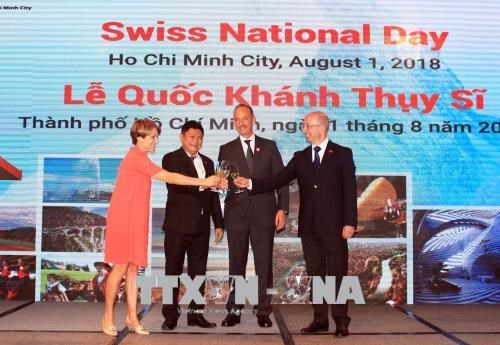
At the celebration for Swiss National Day
The Consulate General of Switzerland in Ho Chi Minh City on August 1 organised a reception to mark the 727th anniversary of Swiss National Day (August 1). On behalf of the municipal authority, Vice Chairman of the People’s Committee Huynh Cach Mang extended congratulations to the European country, stressing that Switzerland is one of the very first western nations to set up diplomatic ties with Vietnam. The bilateral relations have enjoyed sound developments, particularly in trade and investment collaboration, he said, adding that both sides enjoy huge potential for further cooperation. He underlined that Switzerland is an important investor in Ho Chi Minh City, with 72 projects valued at 604 million USD, saying that direct flights connecting Ho Chi Minh City and Zurich, which is scheduled to commence in the end of this year, will bolster delegation exchange, tourism, and trade between the two sides. Mang affirmed that the city always welcomes and creates favourable conditions for Swiss businesses and people to study, set up and carry out cooperative programmes in various sectors, contributing to developing the bilateral ties in a deep and effective manner. Swiss Consul General Othmar Hardegger, for his part, took the occasion to recall the significance of Swiss National Day which helped turn country from a poor nation to a prosperous one. He expressed his delights at the rosy development in the relations with Vietnam over the past 47 years since the establishment of bilaterlal diplomatic ties. In the recent past, high-level visits have created foundation to bolster cooperation in economy, investment, trade, aviation, education and training, and people diplomacy. The diplomat thanked relevant authorities of the Vietnamese city for supporting Swiss citizens, businesses, and the Consulate General in increasing Switzerland’s presence in Vietnam. He said that it will enhance the bilateral ties and bring benefits to both nations.-VNA
Vietnam-Singapore diplomatic ties anniversary marked in
HCM City
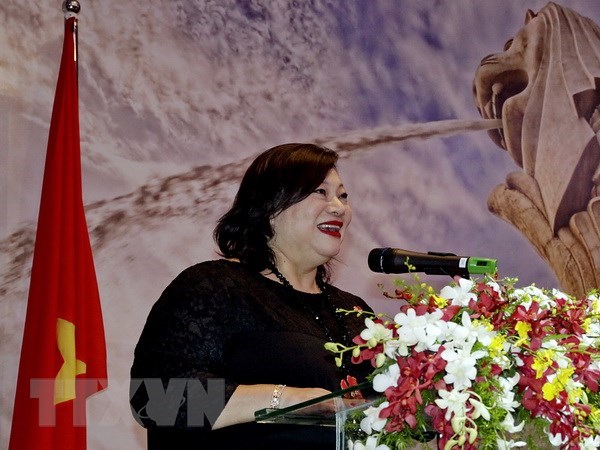
Singaporean
Consul General in Ho Chi Minh City Leow Siu Lin
The People’s Committee of Ho Chi Minh City held a
ceremony on August 1 to celebrate the 45th anniversary of Vietnam-Singapore
diplomatic ties.
Addressing the event, Vice Chairman of the municipal
People’s Committee Huynh Cach Mang highlighted the continuous growth over the
past 45 years of the two countries’ relations in all fields, especially after
the ties were lifted to a strategic partnership level in September 2013.
Ho Chi Minh City is proud to contribute to the fine
relations through the active implementation of cooperative programmes with
Singapore in various fields, Mang said.
According to him, economic cooperation has been a
bright spot in Ho Chi Minh City’s ties with Singapore which is the largest
investor and second biggest trade partner of the city.
Cooperative programmes in education, and socio-culture
have been carried out effectively, thus helping nurture the bilateral
solidarity and friendship.
He affirmed that Ho Chi Minh City wants to further
develop the relationship, particularly in trade, investment, education,
culture, science and technology so as to consolidate the Vietnam-Singapore
Strategic Partnership, for solidarity, friendship and interests of the two
peoples and for peace, stability, and development in the region and the
world.
Singaporean Consul General in Ho Chi Minh City Leow Siu
Lin expressed her delight at Singapore’s top position among foreign investors
in the city with over 1,100 projects totalling 10.5 billion USD, mainly in
real estate and infrastructure.
The country wants to expand its collaboration with the
largest economic hub of Vietnam to new areas such as smart technology, she
said, adding that its experienced and competent businesses can cooperate with
the city in developing and applying smart technologies in urban planning.
She took the occasion to thank municipal authorities
and offices for their support and collaboration, especially through the
organisation of activities to mark the 45th anniversary of bilateral
diplomatic ties such as a painting contest for students, and a Singapore food
festival.
She showed her belief that the relations between
Singapore and Ho Chi Minh City will continued its progress towards a new
height.
Labour productivity key to Vietnam - Japan Initiative
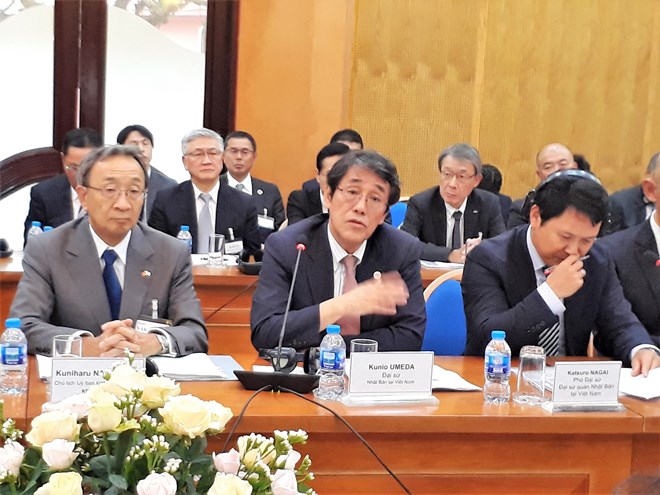
Japanese
Ambassador to Vietnam Kunio Umeda told the meeting
Enhancing Vietnam’s labour productivity is the priority
of the Vietnam – Japan Joint Initiative that aims to improve Vietnam’s
investment environment, a Japanese diplomat has said.
“Vietnam’s labour productivity remains low in Southeast
Asia,” Japanese Ambassador to Vietnam Kunio Umeda told the meeting to launch
the seventh phase of the initiative in Hanoi on July 31. Vietnam needs
measures to improve its labour productivity as it is key to sustainable
development and international competitiveness.
The Vietnam-Japan Joint Initiative was launched in
April 2003 as part of joint efforts by the two governments to improve
Vietnam’s investment climate and expand Japanese investment in the country.
Over the past six phases, more than 470 action plans
have been carried out.
The seventh phase, scheduled from August 2018 to the
end of 2019, aims to cover 10 items, including some left by the previous
phase and new contents.
Nine have been agreed by Vietnamese and Japanese
agencies involved in the phase during the meeting.
According to the Japanese Ambassador, the contents of
the seventh phase reflect the development of Vietnam’s economy.
He expressed his hope the initiative will bring
positive outcomes as they aim to improve the living standards of Vietnamese
people while enhancing the nation’s international competitiveness.
For his part, Minister of the Planning and Investment
Nguyen Chi Dung praised efforts made by Vietnamese ministries and agencies
and Japanese working groups to reach consensus on the action plan for the
seventh phase.
The Minister suggested the Vietnam – Japan Joint
Initiative carry out the phase with a new approach and implementation method
suitable with global integration.
Dung also highlighted the significant achievements in
growing Vietnam – Japan ties, particularly in 2018, when the two nations mark
the 45th anniversary of their relations.
“With the signing of the Comprehensive and Progressive
Agreement for Trans-Pacific Partnership (CPTPP), Vietnam is becoming an
attractive destination for businesses, particularly those from Japan,” Dung
said.
During the meeting, the Japanese side made 65 policy
recommendations, focusing on regulations on investment in Vietnam for foreign
investors as prescribed in the Investment Law, the Law on Enterprises, the
Land Law and other laws.
The recommendations also cover the reform of State
enterprises and the stock market, the intensification of industrialisation
with international competitiveness, labour and wages, and the legal framework
on the public-private partnership (PPP) model.
The two sides agreed on three meetings, slated for late
2018, mid 2019 and late 2019 to review the implementation of its seventh
phase.
Party leader lauds information-education sector
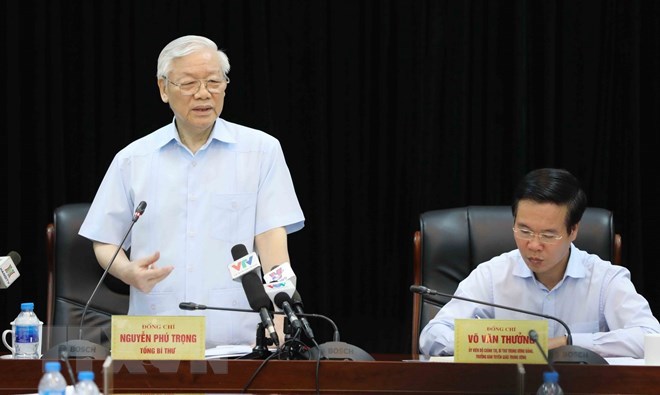
CPVCC General Secretary Nguyen Phu
Trong speaks at the working session
General Secretary of the Communist Party of Vietnam
Central Committee (CPVCC) Nguyen Phu Trong lauded achievements made by the
CPVCC’s Commission for Information and Education during a working session
with its key officials in Hanoi on August 1.
The session took place on the occasion of the 88th
anniversary of Traditional Day of information-education sector.
The Party chief said as a think-tank of the CPVCC, the
Politburo and Secretariat, the commission plays an important role in Party
building in terms of politics and ideology, dissemination of Party viewpoints
and guidelines, press and publishing, culture and education.
After the 12th National Party Congress and amidst rapid
and complicated developments in the region and the world, the commission and
information-education sector have always closely followed the Party’s
guidelines, working agendas of the CPVCC, Politburo and Secretariat, scored
positive achievements and made important contributions to the country’s
common success, he said.
Agreeing with the commission’s report detailing its
seven achievements, seven shortcomings and nine key tasks for the near
future, the leader said the first task of the commission and the sector is
building the Party in terms of politics and ideology, including
Marxism-Leninism and Ho Chi Minh Thought, adding that theoretical research,
education and dissemination are basic and important issues that decide on
orientation to political thought.
According to him, though the press has developed
rapidly with rich and effective contents, communications via words of mouth
remain tardy while management in news on the Internet is limited.
Moreover, the fight against wrongful and distorted
allegations by hostile forces is yet to rally a collective power. He said the
fight against corruption, wastefulness and negative behaviors aims to
continue staying on the path towards the goal of wealthy people, strong
country, and democratic, fair and civilised society.
To that end, the Party must comprise the most
outstanding, consistent and intellectual individuals, thus deserving a leader
of the revolution and servant of the people.
He said information dissemination, building unity in
Party and public consensus is a great responsibility of ideological work,
meaning that it is necessary to grasp public thoughts and aspirations to
offer timely explanations.
The Party General Secretary lauded the commission for
establishing steering boards to step up the fight against wrongful and
reactionary opinions by hostile forces, especially amidst the fourth
industrial revolution with different flows of thought and information on the
Internet, contributing to firmly safeguarding revolutionary guidelines,
stance and nature of the Party.
The commission needs to train a contingent of officials
to meet demand in the current situation, who are qualified, consistent and
absolutely loyal to the Party, he said.
Party committees and authorities at all levels were
also urged to join the effort.
Speaking at the event, head of the commission Vo Van
Thuong said the commission suggested the Politburo issue the Directive
No.05-CT/TW on stepping up the campaign on studying and following thoughts,
morality and lifestyle of Ho Chi Minh and documents guiding the
implementation of the Directive during the tenure of the 12th National Party
Congress.
The commission has also improved the quality of reports
submitted to the Politburo and Secretariat, the efficiency of political
ideology and paid attention to educating Party history in sectors and
localities, towards gradually realising the Resolution of the 12th National
Party Congress and other resolutions of the congresses of Party organisations
at all levels.
Positive progresses have been seen in political
orientations to press and publishing activities, culture and arts, thus
bringing Party guidelines and policies, and State laws into life.
Localities have paid heed to the preservation and
development of traditional cultural values, traditional festivals in tandem
with tourism attraction and socio-economic development.
Over the past years, Party and State guidelines and
policies have also been disseminated abroad so that international friends and
overseas Vietnamese communities could better understand about Vietnam.
It directed ministries and agencies to monitor the
implementation of resolutions and directives regarding education-training,
science-technology, environment, health care, population and social welfare.
Information-education units from the grassroots to
central level have oriented public opinions on issues of public concern,
fought acts that took advantage of abusing democracy, human rights and
religion to divide the nation and incite riots.
VNN
|
|
Growth
drivers need to be upheld: PM
HÀ NỘI – Driving forces for Viet Nam’s economic growth need to be maintained not only in 2018, but beyond, Prime Minister Nguyễn Xuân Phúc said at a Government meeting yesterday. 
Driving
forces for Viet Nam’s economic growth need to be maintained not only in 2018,
but beyond, Prime Minister Nguyễn Xuân Phúc said at a Government meeting
yesterday. — VNA/VNS Thống Nhất
“We should continue working to
create market confidence and win trust of enterprises so as to branch out
business and production”, he stressed.
Regarding the country’s
socio-economic development, PM Phúc noted that four macroeconomic targets
have been ensured, including sound growth of gross domestic production (GDP),
price stability, reduction of unemployment rate and net export turnover. The
nation’s unemployment index fell 2.2 per cent for the first time.
Thanks to institutional reform, the
Government’s direction and benefits from global integration, the economy grew
in the second quarter.
High-tech application has improved
labour productivity, he said, adding that Viet Nam’s logistics index moved
five steps to be in the top three among ASEAN members, just behind Thailand
and Singapore.
However, he pointed out some
short-term risks that the economy may encounter, namely impacts of the
US-China trade war, trade deficit, reversing foreign direct investment flow,
reducing remittances and trade protectionism.
“Our foreign currency reserve is now
at US$63 billion, but it cannot ensure that the economy is able to control
the exchange rate amid impacts of global financial market”, he said,
requesting flexible management of the exchange rate.
PM Phúc agreed not to change
financial policy in the fiscal year 2018, comprising gasoline tax, VAT and
prices of commodities and public services. He ordered tight control of
education and health care service prices to prevent inflation soaring.
He asked ministries to tighten
fiscal discipline, complete budget collection plans and accelerate
disbursement of public investment in line with plans.
Additionally, he urged the
finalisation of public investment law and construction of key infrastructure
works, especially in the transport sector.
Besides export markets, local firms
should pay attention to the nearly 100 million strong domestic market by
improving service quality and food hygiene and safety, he noted.
Regarding slow equitisation in some
State-owned companies, PM Phúc called for inspections in relevant localities.
Ministries and agencies must
complete the draft decree on amending and supplementing business conditions,
he said, recommending cutting the number of commodities that must go through
specialied inspections by half.
Agricultural reform must be
promoted, encouraging firms and co-operatives to land more investment in the
sector to generate incomes for farmers. This should be made in companion with
market reorganisation in processing and manufacturing for sustainable
development for post 2020.
As economic growth is closely
attached to local livelihoods and environment, the Government leader stressed
environmental protection and social order and safety.
He lauded the police forces for
busting a large-scale drug trafficking ring in Sơn La Province and other
serious cases.
He ordered the Ministry of
Agriculture and Rural Development and relevant ministries and agencies to
devise specific programmes in response to natural disasters.
Mentioning critical losses in terms
of officials following wrongdoings in the Ministry of Public Security and the
Ministry of Information and Communications, PM Phúc called on Cabinet members
to set the example in implementing the Resolution adopted at the 4th plenum
of the 12th Communist Party of Việt Nam Central Committee on enhancing Party
building and rectification, and preventing and curbing ideological, ethical
and lifestyle degradation as well as the manifestation of “self-evolution”
and “self-transformation” inside the Party.
Việt Nam
witnesses robust socio-economic development in 7 months
Việt
Nam recorded robust socio-economic development in the first seven months of
the year, with a stable macro-economy and good control over inflation in the
context of the escalating US-China trade war, said Minister-Chairman of the
Government Office, Mai Tiến Dũng.
Speaking at a press conference after a regular government meeting yesterday, Dũng said the consumer price index (CPI) in July dropped by 0.09 per cent from the previous month after increasing for three consecutive months. The average CPI in the seven-month period went up 3.45 per cent, which was lower than the 3.91 per cent recorded in the same period last year, he said. The industry sector was the key driving force behind the nation’s economic growth. The industrial production index in July shot up 14.3 per cent compared to the same month in 2017, which was its highest expansion since February. The agricultural sector also posted impressive results, with aquatic output surging 5.7 per cent. The stock market made a remarkable recovery when the VN-Index on the Hồ Chí Minh Stock Exchange reached 934.08 points on July 24, and the total capitalisation value of the stock market rose 8.3 per cent from the end of 2017. During the January-July period, Việt Nam enjoyed a trade surplus of US$3.1 billion, equivalent to 2.3 per cent of export revenue. Regarding foreign direct investment (FDI), Dũng pointed out the sound growth in foreign capital. Foreign firms registered to invest nearly US$23 billion in Việt Nam while FDI disbursement was estimated at more than $9.8 billion, an on-year surge of 8.8 per cent. Positive signs were also seen in the private sector. Nearly 75,800 new enterprises were established nationwide in the first seven months of the year with total registered capital of VNĐ771 trillion ($33.34 billion), an on-year rise of 3.9 per cent in the number of firms and a 11.6-per cent rise in terms of capital. Meanwhile, 18,696 companies resumed operations, up 6.5 per cent from the same period last year. International organisations recognised Việt Nam’s economic reform efforts, and gave optimistic outlooks for the nation’s economic growth. Of them, the Asian Development Bank (ADB) forecast that the Vietnamese economy will expand 7.1 per cent this year, while Standard Chartered predicted economic growth of 7 per cent and inflation of around 4 per cent. In the United Nations’ sustainable development goal (SDG) index, Việt Nam moved up 11 places to rank 57th out of 156 countries and territories, and third in ASEAN, just behind Singapore and Malaysia. Regarding the Global Innovative Index 2018 (GII Index 2018), Việt Nam rose two positions to 45th among 124 countries and territories, and 4th in ASEAN after Singapore, Malaysia, and Thailand. The latest report from the World Bank (WB) indicated that Việt Nam’s Logistics Performance Index had moved it 25 places to 39th place among 160 surveyed countries. Dũng also pointed out shortcomings in the socio-economic situation, including complicated weather developments, price hike pressures on the macro-economy, barriers facing local firms looking to expand, and slow equitisation of state-owned enterprises. He said that at the Government meeting, Prime Minister Nguyễn Xuân Phúc ordered relevant sides to work on solutions to effectively address these issues.
VNS
|
|
VND4.1bn tax arrears bill for man
profiting from online business
Nguyen Nam Binh, vice head of HCM City Department of Taxation, said on
August 1 that they had collected VND4.1bn (USD164,000) in tax arrears and
fines from a local man that earned VND41bn from Facebook and Google ads.

illustrative image
The man
is a programmer whose game has been viewed and downloaded on Facebook, Google
and YouTube. He earned over VND41bn (USD1.6m) from ads in 2016 and 2017 but
didn't make any declarations or pay taxes.
He
promised to VND3bn in tax arrears and a VND1.1bn (USD44,000) administrative
fine. The tax arrears were detected when the Department of Taxation ordered
banks to check on incomes from Google, Facebook and YouTube that haven't
deduced taxes. Binh said they would continue checking other cases of huge
online incomes.
Another
individual in HCM City also earned VND30bn online but hasn't paid taxes. The
Department of Taxation said he was no longer living at the HCM City address
so the case was transferred to the Department of Taxation in Quang Nam where
the individual originally came from.
Binh said
the Law on Tax Administration required all businesspeople to pay tax. He went
on to say that both Facebook, Google, YouTube as well as local individuals
and firms that use the services hadn't fully complied with the tax
regulations.
The
authorities will zero in on Facebook accounts that are the most active and
have large incomes. Those who earn less than VND100m (USD4,400) a year online
must pay a business licence tax. Those with over VND100m of annual incomes
must pay additional VAT and personal income tax.
According
to the Department of Taxation, Facebook, Google and YouTube incomes at four
banks are in the range of VND500bn (USD20m).
Last
year, the Taxation Department has collected VND9.1bn (USD400,100) in tax
arrears from a Facebook account that sells cosmetics online.
nguoilaodong,
dtinews.vn
|
Đăng ký:
Nhận xét (Atom)