|
Ancient stones help
musical M'nong to rock
Pham Van Phuong,
from
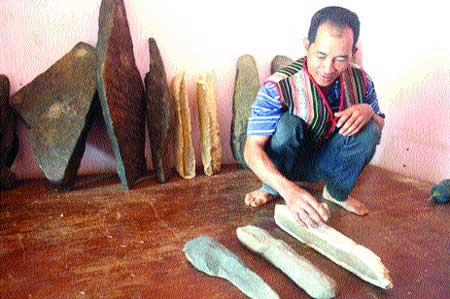
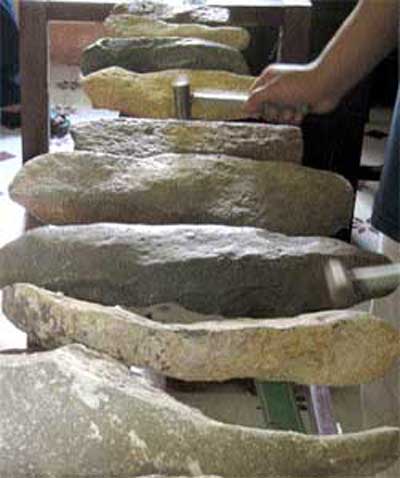
The lithophone is an ancient musical
instrument made from slabs of stone. It was first discovered in Dak Lak in
1949.
The ethnic people of the Central
Highlands call the stone instruments goong lu, which means "rock
gongs". They are an ancient percussion instrument from
The instrument is made of stone slabs
of different sizes. The long, thick slabs sound bass notes, while the short,
small, thin ones sound the higher notes.
The ancient people from the various
mountainous regions in Southern Central and
In 1956 a second set of rock gongs
was discovered and brought to a
The Cultural Space of the Gong in Tay
Nguyen was recognised by UNESCO as a Masterpiece of the Intangible Heritage
of Humanity.
Vietnamese archaeologists have been
collecting and researching these stone instruments since 1979.
The third set was found in
In the early 1990s, 200 musical stone
slabs were discovered in Dak Lak, Khanh Hoa, Dong Nai, Ninh Thuan, Lam Dong,
Song Be and Phu Yen. Each instrument set contains three to 15 pieces.
The most famous sets of stone
instruments are named after the places where they were discovered, which
include Khanh Son, Bac Ai, Tuy An and Binh Da. Scientists say that the
lithophone from Binh Da is about 3,000 years old.
Phuong, born in 1977, now lives in
Quang Tin Commune, Dak R'lap District. His father is from the Kinh ethnic
majority of
The five lithophone sets that he
discovered now bring unique acoustic sounds to the festivals and sporting
events in his region.
The lithophone is now recognised as
an extremely precious heritage in
Local musician Dieu Nhom says,
"Once upon a time, these stone instruments seemed to have disappeared,
but in the 1990s, some local villagers discovered a set of stone
instruments."
Then, the first lithophone set was
taken to a museum in Dak Lak where experts confirmed that it was an ancient
instrument of the M'nong.
Phuong says most of his stones were
found in the Dak Ka stream during the dry season.
"After discovering the first
set, I brought them back to the village elders and musicians to have them
appraised and they recognised that these stone slabs were actually part of a
musical instrument.
"Villager elders encouraged me
to look for more lithophones. Since 2001, I have found many more stone slabs
of various sizes in Dak Ka stream, and the ring of their notes sound like
gongs. I brought them back to the village and the elders studied them before
arranging them into three sets."
The experts currently evaluating
stone instruments for Phuong include Dieu Dua, Dieu Teu and Dieu Nhom.
After several days of wondering
around the stream, Phuong discovered five sets of stone instruments, with
each stone slab weighing from 5kg to 15kg.
Phuong says he collects the stone
instruments for more than just exhibitions.
"The local authorities borrow
the instruments for musicians to play at meetings, festivals and sporting
events, but very few people actually know how to play them. Most of the musicians
can perform between three to five songs," he says.
Phuong's lithophone collection is
considered to be the largest in Dak Nong.
Dieu Dua says, "A sense of
national identity has helped Phuong feel the "soul" of the musical
stones to preserve ancient culture for our village. Currently, the district's
Culture and Information Office has borrowed a lithophone set to perform music
at festivals in the province."
Today many people across the country
know about the young man who collects stone instruments, even some collectors
have come to Phuong wanting to buy his lithophones.
"The instrument's echo, the
colourful culture and my love for traditional ethnic culture would never
allow me to even think of selling them," Phuong says.
Moreover, he plans to continue finding
and collecting more stone instruments.
Thanks to his efforts,
Through his passion for antiques,
Phuong's collection has helped to increase knowledge about the musical instruments
of the M'nong, while also enriching the lives of people with the sounds of
ancient music during local festivals and sporting events.
Source: VNS
|
Chủ Nhật, 18 tháng 8, 2013

Đăng ký:
Đăng Nhận xét (Atom)
Không có nhận xét nào:
Đăng nhận xét