|
Larry
Berman and the “Perfect Spy” (Part 1)
VietNamNet's Viet Lam talks with Prof.
Larry Berman, author of bestseller “Perfect Spy”, about legendary Vietnamese
spy Pham Xuan An.
Viet Lam: The first
edition of “Perfect Spy” was published seven years ago and the second edition
was released last year with a new title “Perfect Spy X6”. What is the
difference between the two editions?
Larry Berman: Well, the
biggest change in the two editions is that in the new edition, that is the
word-for-word translation of the English copy of Perfect Spy.
In the first edition, it was more a summary in general,
very good translation but not word for word...and of course X6 was the code
name of Pham Xuan An. So the biggest difference is that.
The second biggest difference is the existing book has
special letters that I shared with readers for the first time from An, also
letters from the members of the H.63 network. And finally it has an essay by
me of the things that Pham Xuan An told me that could not be published in the
first edition, but I used in the second edition.
Viet Lam: Many readers
have sent us this question “What inspired you to keep writing about Pham Xuan
An”?
Larry Berman: Pham Xuan
An was the most interesting person that I have met in my life for many
reasons.
First of all, he was a spy, the most successful spy
during the whole Vietnam War and he let me write his life story. As I got to
know him, I realized that his life was something much more than just spying.
It was about the struggle of the Vietnamese people but also the struggle of
Pham Xuan An after the war and what happened to him.
So I find that his whole life was so interesting that I
just keep going back and forth with him. And of course, many Vietnamese
readers buy the book. It becomes popular, so why would I not keep writing?
Viet Lam: There are
many Vietnamese and Americans writing about An. We wonder why An chose you to
share his secrets, his life and reports?
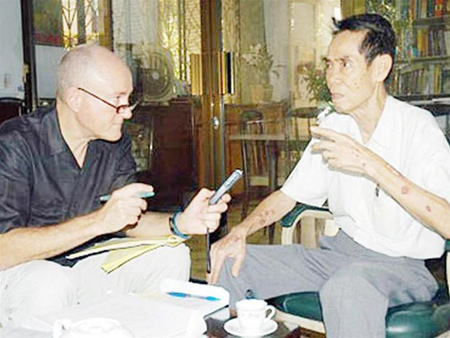
Larry Berman and Pham Xuan An.
The photo is provided by the author.
Larry Berman: I talked
about that in my book. An selected me for several reasons.
At first he did not want me to write the book. He did
not want anyone to write the book. Many people who knew him during the war
are famous journalists like Stanley Karnow and others. They offered An
$500,000 to write his memoirs. And An kept saying "No, because if I tell
the secrets, too many people would be hurt".
And then An got very sick and was dying. He thought he
would have only six months to live and I was with him and I said to him that
"your story really needs to be told". He finally agreed. He chose
me to tell because he had read my other books and he thought I was the
fairest American historian on controversial subjects and that I would be
independent and that I did not know him during the war. I had no view of the
war and no service in the war. Therefore, I can address this. That is why he
selected me. I think An knew my commitment to him
Viet Lam: Had you
ever read any article about Pham Xuan An before you started writing about
him. After many meetings with An, what was your perspective about him? Who
was the real Pham Xuan An?
Larry Berman: When I first
met Pham Xuan An in Ho Chi Minh City in the summer of 2000, I sat to have
dinner with him but I did not know who he was and we spoke for about four
hours together about his time in California, his career in journalism, about
who he knew, and he never mentioned anything about spying.
I found that he was one of the most interesting,
engaging talkers. After dinner, I learnt who he was and I read everything I
could about him and I really wanted to get involved with him and write his
story. Then I read everything about Pham Xuan An.
But at first I knew very little about Pham Xuan An.
Most are published by Vietnamese journalists who have written about his life
story in general, his secrets and intelligence. That was not the kind of
story An wanted. These stories even embarrassed him. He wanted an American
historian to write history.
Concerning the answer for who is the real Pham Xuan An,
we will never know who the real Pham Xuan An is.
We do know Pham Xuan An through several remarkable
stages of his life, his mission to his country, his obligation. He wanted to
fulfill his mission to his country and went to the
An was the only Vietnamese after the war who truly understood
the American people, not just the reason for the American government's waging
the war. And he saw that goodness, spontaneity and friendship and he admired
the American system. And he was a very lonely man for the large part of his
life because he could not bring those ideas to the Vietnamese people.
Viet Lam: You
mentioned a very interesting thing about Pham Xuan An, not just as a perfect
spy, but more than a remarkable personality and a lonely spy. This is also
relevant to the question of a reader named Nguyen Giang: “Is Pham Xuan An
more a patriotic communist or a journalist who fought for his people’s
independence?”
Larry Berman: That is a
good question and thank you for asking it.
Pham Xuan An is a patriot, I say that in the book. But
by patriot, I mean he joined the revolution when he was a very young man and
he believed that no foreign army and no foreign country have the right to
determine
To Pham Xuan An, that was what the revolution was
about:
When he joined the Party, he did not know anything
about Communism and the whole time he worked as a spy, he had never gone to a
Communist meeting. He did not know anything about that because he was working
as a reporter for an American newspaper on his mission. So when the war was
over and someone said “Oh, you are Communist now”.
An said “I am a patriot, a Vietnamese that fought for
independence”. That is how I answered that question. It is not black and
white. It is very complicated.
And as readers of my book know, from 1975 until the day
he died, Pham Xuan An became a leader of reconciliation between our two
countries. He was the VIP on the USS Vandegrift the first US ship to visit
Viet Lam: You met An
many times, and also his colleagues in the H.63. Vietnamese spies had not
been trained professionally. So, how could An and his colleagues be
successful with such training?
Larry Berman: Well, first
of all, the first thing I learnt when I interviewed many members of the H.63
network. Of course, many of them died protecting Pham Xuan An; their whole
mission was to protect Pham Xuan An.
I was able to interview many of the key members of the
network like Tu Cang, Ms Thao and the others in this town. Those are the ones
who lived and survived but many in the H.63 died protecting Pham Xuan An.
That is the first thing that I learnt and that was very important.
Pham Xuan An learnt about spying from reading books,
and from thinking about it and adopting the coverage of journalists. But he
did not go through the training as a formal spy. He got it from reading
books. So, he was self-taught or taught himself how to do this successfully.
He taught himself how to write invisibly, he learnt about a career system,
from reading about it and testing it out.
Of course, there were many other Vietnamese spies who
were caught. He was the only one who went the entire war and did not get
caught and was even promoted. So many others, and even three spies who were
promoted to the rank of general, but two of the three had to flee. Only Pham
Xuan An survived. That is why I called him the perfect spy.
Viet Lam: So, did An
tell you about the amount of exact intelligence information that he sent to
Larry Berman: He told me
that he sent a lot to
Viet Lam: Seven years
ago VietNamNet published a special series about the H.63 spying network. We
received a number that An sent about more than 400 reports to
Larry Berman: I think it
is very impressive. An won 16 or 17 medals for his contributions to the
victory but four or five of them in particular are Ap Bac of the 1965
escalation, the Tet Offensive. His report, we know, was crucial for the
success of what General Giap tried to accomplish. Without a doubt, 80% is
quite impressive. How did he get that information?
An did not steal things from the Americans. He was a
reporter, but he was also a very personable, bold and intelligent, we call,
human intelligence. He actually became a very close friend with the South
Vietnamese CIO, their intelligence office. Here, the intelligent officers
would give him documents as they thought he was a reporter…
He was a master of getting people to give him materials
so that he could use his analysis and write his reports. That was the key. He
was a great intelligent analyst of the materials that he received, both
intelligence and military.
Viet Lam: This
question comes from a reader named
Larry Berman: No, I do not
think so. I think if the CIA thought that An was a spy, he would be dead. I
have been asked that question before, but I do not think so. He had many
friends in the CIA and a good working relationship with the CIA as a
reporter. The CIA relied on An for tips because they thought he was a good
non-Communist source. But they never suspected An of being a spy. If
they had, he would have been dead.
In my book, I tell the story that the CIA actually
recruited An. The CIA came and asked An. An and I talked about it. They tried
to get An to be an agent for them. And An did not know what to do because he
was a Communist agent and the CIA did not know that. An did not know the
future and he would accept the job so that he could infiltrate the CIA. So he
sent a message to
To be continued… |
Thứ Ba, 7 tháng 10, 2014

Đăng ký:
Đăng Nhận xét (Atom)
Không có nhận xét nào:
Đăng nhận xét