|
Larry Berman and the “Perfect Spy”
(Part 2)
VietNamNet would like to introduce the
second part of columnist Viet Lam’s talk with American writer Larry Berman
about his book entitled "Perfect Spy".
Viet Lam: This is a
question from Do Hung, the translator of the second edition: “As I was
reading and translating this book into Vietnamese, I had an impression that
you have many untold stories about Pham Xuan An. So, since the second edition
has been released, do you intend to reveal certain secrets? And could you
talk about them now?”
Larry Berman: Do Hung is a
good reporter. He never stops asking questions and this is a good question.
There is only one or two things that An told me that I
will never tell anybody. They are not earth-shattering. They are more
personal about people. And as long as those people are alive, I cannot tell
those stories.
But he told me nothing about the secret of his spying
that I have not written about or shared or anything like that. There are two
things that personally I just cannot disclose. But there is no smoking gun.
So, everything that I know about Pham Xuan An is in
this new edition. With one edition, which is in the TV series (we talked
about the TV series), I think we are trying to add something that will be
new.
Viet Lam: A reader
asked: “Do you have any intention to release another updated edition of the
book with new details in the future?
Larry Berman: I think
that there would not be enough to compose a new update of the book. There are
a lot of new materials in the new translation. There are new perspectives. I
have been asked and I think I will write a book about the H.63 network, Tu
Cang… That would be an interesting feature, right? He was interested in doing
this, which would be good.
There is a problem for me, which is that, An spoke
English and he spoke English very well, so I was able to interview him and
and speak very easily. But most of the H.63 do not speak English like An did.
It would be more difficult for me because I do not speak Vietnamese.
So I am still thinking about what to do. I want the
readers to know that I do not have any big secrets that are hidden and that I
cannot talk about. I have tried everything I can in this book, except
personal things that An told me that are not about things people would
necessarily think worth sharing.
Viet Lam: The first
impression when I read the book is that you made very clear that the special
factor from An is that he lived a very truthful life under his cover. That is
what you call “incredible double life”. Many readers might think that it is
unbelievable for a spy to live truthfully among lies. So, after your meetings
with An, could you explain it to me and our readers?
Larry Berman: This
question has come to the key of Pham Xuan An because he was hiding a play
inside; that is what he was doing: hiding a play inside.
How could he do it? In the book, I talked about this
and An and I talked about it. In order to survive, he became his mask. In
order to succeed as a spy, he had to become the very best journalist that he
could. And he totally became that person because he did not make any slip.
So, by becoming that person and living that mask for so
long, he became a very successful spy. But the consequence, the result for
Pham Xuan An, was that when the war was over, and they said OK, you do not
have to be a spy anymore. Who was An? He did not know in many ways because he
had lived that mask and had been someone else for so long. Who was he going
back to being?
The person he was going back to being had been a 25
year-old kid. And now he was 50. How long it would be for him to cover up
what had been gone? So I think he did it by becoming his cover, or becoming
his mask. But then he had to live the rest of his life with the consequences
of that.
Viet Lam: Many
readers sent us the same question: “Did you hear what An thought about
Larry Berman: It is in my
book that I discussed the two questions. The first question is “Did An
discuss with me how he thought about
At least, and I think it do not think it is any secret,
An was disappointed after the war. He thought that the reconciliation would
happen very quickly. He was naïve about that. He thought that there would be
reconciliation between North and South, and also between
The consequence was that he paid a great price for
that. He did not have a visitor for a long time and he never was able to go
to
Once I asked him that question I thought maybe he
regretted going from the
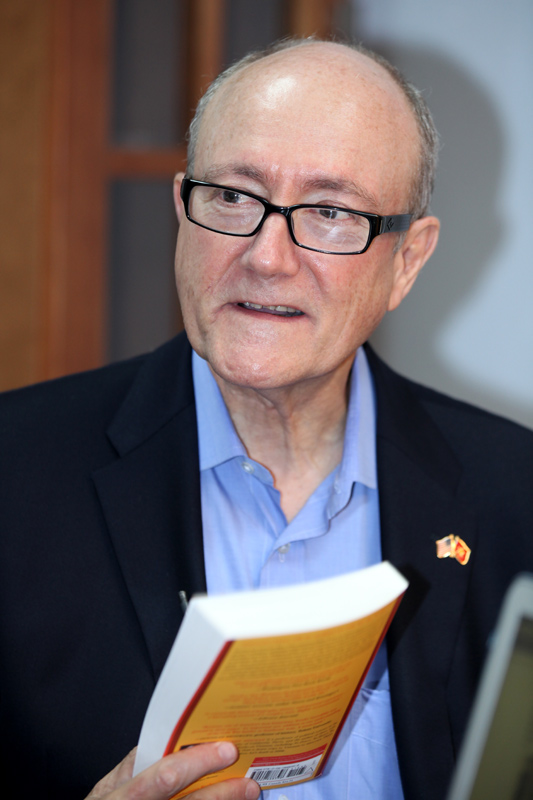
Prof. Larry Berman.
Then he would not have waited for the instruction from
When I first met An, he took a box shell. And in that
box, he would save everything from when he was a student in
Viet Lam: You described
An as a lonely spy, lonely hero. I think this is common for many spies.
Another thing I felt from what you said is that he was a man many internal
conflicts. What do you think about it?
Larry Berman: An had
worked his cover as a journalist so he experienced the American way of
journalism, free press, the ability to think and write in a totally different
way. An wanted that for
When the war was over (since he was an expert of
America, he had spent 20 years studying in America), he thought that the new
Vietnamese leadership would turn to him and say "OK, what you learnt is
helpful, so what do you think about journalism, about the media, press and
new ways of thinking that have made you such an interesting and engaging
personality?" Then he felt that no one was interested in that. He could
not practice his trade, he could not be a journalist. And he was very
conflicted, so he had to shut up. I mean that is what happened because he
made a trade.
I talk about that in the book. Under certain terms, he
agreed to stop talking like he was talking. In return, the government allowed
his first-born son to go to the
Today, his son is living that dream. He is one of the
most important people in the new
Viet Lam: I think that
we are so lucky now that everyone, even the leaders, can look back at the
past and laugh at those naïve things in the past, right? That is why you can
write about Pham Xuan An and publish in
Larry Berman: Yes, it is
a big change, a new
Some young historian will be able to write their book
and people will say that I remember Larry Berman many years ago...but if he
had been able to see all the report, he would have been able to write a
better book, which is true ...and I am also excited. I just want to tell the
listeners that I am very excited. Yesterday I met with the screenwriter of
the 30-episode television show based upon this book.
I think it would be a great interest in
Viet Lam: This is
another question from our readers: “Is there anything that you regretted that
you had not been able to ask An?
Larry Berman: We would
need another two hours to answer that. There are many things that I regret
not asking An.
I am smaller today than when I was interviewing him. I
know somewhat more things I would have pressed him on more about: some of the
medals that he won and I did not even know about until after my book was
published. I would also love to know about his role in Lam Son 719, which is
a really important military excursion that An was involved in what we now know.
But I would love to ask him more about his report.
And I would like to ask him about some of the issues
with the CIA as well. So there are many things I would like to ask him if I
could.
I once asked An if he had any regrets and I have been
asked this question a hundred times. And he said "no, because I had to
do what I did. There is no sense crying over spilled milk. I had to do my
mission. We had to get rid of the Americans. So I do not regret what I did. I
just regret how it all turned out." That is a very interesting answer.
That is another book right there.
Viet Lam: Audiences
are now expecting the film about Pham Xuan An, which is expected to be
released next year and we are sure that it could be a very interesting film.
That is quite related to the context in
Larry Berman: I am glad
that you asked that question. This is the film that would be 30 episodes,
dramatic television recreation based upon my book. It is not a documentary,
not a historical documentary at all. This is made for television, a drama
series. The screenwriter is Phan Thuy Nhan and I met him yesterday and we
were talking about that. His writing is a different mode than history
documentary, which no one will watch. I agree with that.
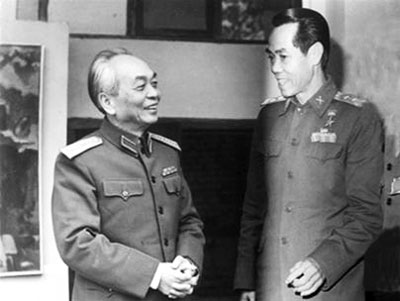
General Vo Nguyen Giap (left) and Major-general Pham Xuan An.
The director Bui Tien Dong is thinking about it as a
dramatic episode TV series based upon the book. So it is not going in
chronological order. It is going to have a love component, drama, a
friendship, spy, and deception. And we are told that story. Then they hope
people will want to watch and they will know that is based upon Larry
Berman's Perfect Spy X6. But they will take license as well, creator's
license and make it appealing to the public.
I am very happy about that and I will be a consultant
on it so we spent a lot of time talking about the character development.
Hopefully people will watch because it will be a different kind of document.
It is not a documentary, it is a TV series, a TV drama show.
Viet Lam: You
answered my question about what makes a historical book or film appealing to
the audience. That is, you told a story through personal destiny and a
personality, which makes it more appealing?
Larry Berman: It is a
dramatic recreation based upon the book. So, it is not going to be a series
from page one to page 40. It is not straight history. Human interest,
personality, love, An, An's love, his love of his country, love of his
girlfriend in
This TV series will be in English and Vietnamese
because there are so many Americans in An's life. So there will be both
Vietnamese and English subtitles. So I think drama will help, it is not just
a docudrama.
Viet Lam: Is there
any chance for the audience to hear An’s voice? It means that you recorded a
lot of meetings with him. Is there any chance in the future you will release
those tapes?
Larry Berman: Yes, it is
my intention to release all the tapes. I am going to make them all available
to any researcher in the world. I am going to do this in a very short time so
that people can listen to these tapes anytime. I am very happy, too.
Viet Lam: And the last
question: You said the book is not about spying. You want to tell a story of
a personal life of a spy. So what you want to tell Vietnamese readers?
Larry Berman: The book is
about spying and a spy, but the big story is about a man's life and the way
he negotiated, the conflicts and challenges of that life and how it became an
extraordinary life. So it is a story about patriotism, about services, spying
and reconciliation.
One picture in the book, the most important one is on
the USS vessel, and there is An and his son on the very first ship that ever
came to
That is, the story of Pham Xuan An is about the perfect
spy on the top, but also the incredible life of this man who went from being
a top spy in the world, a general, a hero in the revolution, to become one of
the most important people of the reconciliation between the two countries.
That is an amazing story, very unusual.
Hopefully that answered your question.
VietNamNet
|
Thứ Bảy, 11 tháng 10, 2014

Đăng ký:
Đăng Nhận xét (Atom)
Không có nhận xét nào:
Đăng nhận xét