Vietnam deputy minister says Long Thanh airport to cost over
$18bn
It is estimated that the megaproject
to build an international airport in the southern province
of Dong Nai to share the overloading
burden with Tan Son Nhat International Airport
in Ho Chi Minh City will cost more than US$18
billion for all three phases, Vietnam’s
deputy transport minister said Friday.
The money generated from selling the land
plot where Tan Son Nhat – Vietnam’s
largest airport – currently sits, as proposed by an economic expert, thus
would not be enough to cover the enormous investment for the project, Nguyen
Hong Truong told reporters in Hanoi.
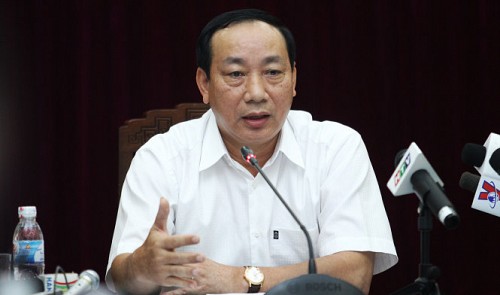
Truong addressed a media meeting after Nguyen Xuan
Thanh, director of the Fulbright Economics Teaching Program in Ho Chi Minh City,
suggested shutting down Tan Son Nhat airport to help finance the construction
of the Long Thanh terminal in Dong Nai.
The 800 hectare land plot that would be left if the
airport were closed could fetch no less than $8 billion, the Harvard Kennedy School
senior fellow said in an op-ed published the same day in Tuoi
Tre (Youth) newspaper.
Thanh proposed that the government should consider closing
down Tan Son Nhat and making use of its land plot after 2025 – three years
after Long Thanh is expected to be put into use – instead of operating the
two airports at the same time, as originally planned.
The Ho Chi Minh City-based newspaper questioned the
deputy transport minister over the possibility that the new, costly airport
investment will increase Vietnam’s
public debt at a time when less than 30 percent of the state budget is
earmarked for investment and debt clearance.
Truong said that the government will contribute around
VND84.62 trillion ($3.98 billion), funded by government bonds and official
development assistance (ODA) loans, to the total investment for the first
phase of the megaproject, estimated to cost some VND164.57 trillion ($7.83 billion).
“The transport ministry has stated clearly in the
report submitted to the National Assembly Standing Committee that borrowing
ODA loans would only result in a 0.029 percent increase in public debt,”
Truong said, underlining that it is “a low ratio.”
“The ODA loans to fund the Long Thanh airport account
for only 0.1 percent out of the total such loans for other infrastructure
projects,” he added.
The transport official said the Ministry of Finance,
which is the National Assembly’s public debt consultancy, will develop a debt
payment plan on an annual basis.
Truong said the government capital in the project will
be allocated to site clearance and compensation, as well as basic
infrastructure construction, including traffic systems and the airport’s taxiways
and aprons.
“These construction units need to be funded by the
government as we cannot call for private investment in facilities that do not
make a profit,” he explained.
The transport ministry has said it is essential that
Long Thanh airport, located in the eponymous district in Dong Nai, be built
to ease pressure on Tan Son Nhat, which is expected to become overloaded by
2017.
Long Thanh is about 50km away from Ho Chi Minh City.
The Ho Chi
Minh City terminal now handles around 20 million
passengers a year.
The 5,000-hectare Long Thanh airport is forecast to
receive 25 million passengers a year during its first phase, ending by 2025.
While the overloading of Tan Son Nhat could be solved
by expanding the terminal, the deputy transport minister said it would cost
as much as $9.1 billion to take the capacity of the airport to 50 million
passengers a year.
Part of the money needed for this expansion is to
compensate 500,000 people from 140,000 households that will have to relocate,
Truong elaborated.
“The investment is far bigger than building a new
airport,” he said, adding that Tan Son Nhat airport must be kept to serve
domestic or military services.
Meanwhile, the Airports Corporation of Vietnam (ACV),
one of the investors of the Long Thanh project, is upbeat about resolving the
funding issue of the costly terminal.
“We will borrow ODA loans from the government, and will
repay the debts by ourselves,” ACV chairman Nguyen Nguyen Hung told
reporters.
Hung said the investors demand that the government earmark
VND18.5 trillion ($870.75 million) for site clearance and compensation, and
they will cover the remaining investment.
“We have in fact succeeded in building the Tan Son Nhat
terminal and the T2 terminal at Hanoi’s
Noi Bai airport through this method,” he asserted.
VIR
|

Không có nhận xét nào:
Đăng nhận xét